Asia Pacific Round Up, 15/12/11

Below are a number of links to articles I have found interesting over the last week or so. Feel free to commence on them below or link to an interesting article of your own.

1. http://www.telegraph.co.uk/news/worldnews/asia/china/8954315/Inside-Wukan-the-Chinese-village-that-fought-back.html
Malcolm Moore’s excellent article for The Telegraph about Wukan, a village rebelling against local officials’ misrule.

2. http://www.taipeitimes.com/News/front/archives/2011/12/15/2003520765
Interesting story from Taiwan about the ROC’s interest in developing a its submarine capability.

3. http://www.nytimes.com/2011/12/14/sports/soccer/14iht-soccer14.html
The villagers in Wukan may not be happy with their economic prospects, but Nicolas Anelka won’t have to worry where his next baozi is coming from.

4. http://www.cfr.org/russian-fed/why-russian-protests-matter/p26773
Interesting CFR interview with Stephen Sestanovich regarding the recent anti-Putin protests in Russia.

5. http://www.bbc.co.uk/news/world-asia-16190926
China’s new aircraft carrier has been spotted in the Yellow Sea.

6. http://www.foreignaffairs.com/articles/136718/evan-a-feigenbaum/chinas-pakistan-conundrum
America isn’t the only country with a difficult relationship with Pakistan.

7. http://www.guardian.co.uk/world/2011/dec/15/deported-tamils-torture-sri-lanka?
Tamils forced to return to Sri Lanka face an uncertain future.

8. http://timesofindia.indiatimes.com/india/Anna-Hazare-wants-Parliaments-Winter-Session-extended-to-pass-Lokpal/articleshow/11117623.cms
Anna Hazare continues his fight against corruption in India.

9. http://www.atimes.com/atimes/Korea/MK08Dg01.html
Andrei Lankov on the rise of Kim Jong-eun.

10. http://www.japantimes.co.jp/text/nn20111214a3.html
The Japan Times is reporting that Japan will choose the F35 as its 5th generation fighter.

Enjoy!

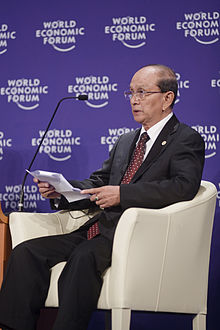
What explains Myanmar’s volte face?

Myanmar President Thein Sein

While the Arab Spring has caused more ink to be spilled in attempts to explain why supposedly stable regimes were in reality brittle and vulnerable, another authoritarian state has begun to tentatively open up to the outside world. Much to the surprise of analysts who thought that the 2010 Myanmar elections would prove to be a sham that merely airbrushed the junta’s continued rule, recent events have suggested that the regime may be serious about liberalising.

Under the Presidency of Thein Sein, a former military officer, the new ‘civilian’ government, though it is composed of former senior military officers, has passed a new law loosening the ban on protests, though this has yet to be tested. Would-be protestors are required to apply for permission at least five days in advance.

Meanwhile, in an apparent attempt to address Myanmar’s ethnic divisions, the government has been reported to have called a ceasefire with the Shan State Army South, an armed ethnic rebel group. Aung San Suu Kyi, the country’s iconic pro-democracy activist, has also been released from house arrest and it seems that she will be permitted to return to politics.

Finally, the most obvious sign that the regime in Naypyitaw is liberalising somewhat is US Secretary of State Clinton’s recent visit. Allowing such a prominent figure to visit stands in marked contrast to Myanmar’s rejection of American aid in the wake of Hurrican Nargis.

The source of such a surprising turnaround is unclear. Some analysts have suggested that a rapprochement with the West could be motivated by a desire to avoid becoming too dependent upon China. However, while Naypyitaw has relied upon Beijing for arms and investment, particularly in the resource sector, it is also true that Thailand and India have proved to be more lucrative export markets. Myanmar is not the Chinese vassal state it is often portrayed to be.

Others, meanwhile, have suggested that some in the regime may have been repelled by the scale of the violence employed against protesting Buddhist monks in 2007. The military officers who formed the junta and who are now comfortably ensconced in the current civilian government have not, however, done anything in the past to suggest that they are squeamish about using force to perpetuate their rule, so this seems an unlikely motivation.

It seems more likely that events in the Middle East during the Arab Spring have concentrated the minds of those at the head of government. It seems plausible that they hope to tread a fine line between liberalising enough to give the average citizen a stake in their society and losing control, a path that Beijing is also attempting to stick to.

They may also hope to copy Pyongyang’s playbook: as a point of convergence between the great powers in the region, Naypyitaw may hope to play off the Chinese, Indians and, to a lesser extent, the Americans, against each other to its own advantage.

In short, the reasons behind Myanmar’s surprising direction are unclear. Thein Sein may prove to be Myanmar’s Gorbachev, though it should be noted that Gorbachev had no desire to break up the USSR, he simply wishes to modernise it. It seems safe to assume that those in government wish to preserve their leadership and that this desire will influence future decision-making.

A Declicate Balancing Act

We stand, in the words of Coral Bell, at the end of the Vasco da Gama era, having witnessed the apogee of Western domination over the international system.  For the first time in the modern era, Asia is taking its place alongside North America and Europe as a major centre of wealth, power and political weight.

A key driver of this re-emergence is the rise of China which has led scholars to consider the consequences for Asia’s strategic order.  Power is shifting East, goes the argument; power relativities are in flux. America, for so long the greatest power in Asia, will find its primacy to be increasingly unsustainable.

Inspired by the 19th century Concert of Europe, some commentators, seeking to mitigate the kind of conflict that has historically haunted power transitions, have suggested that Washington should surrender its primacy and instead embrace a system that would see it wield power in concert with the other great powers of Asia.  By sharing power with China, they argue, America could allow Beijing to maximise its power peacefully.

It seems obvious, however, that instead of the emergence of a concert of power, what is actually developing is an old-fashioned balance of power.

A balance of power creates order through the competition of major powers as each strives to improve its own position and prevent another from dominating. This balance restrains states’ behaviour as they realise that threats to the equilibrium will be met with balancing behaviour from other powers.  Such a balance seems to be emerging.

Firstly, at the recent APEC meeting, Washington signalled its determination to develop a Trans-Pacific Partnership, a free-trade area that could eclipse the European market.  While the U.S. is keen to avoid the perception that it is marginalising Beijing, it has also made it clear that Chinese participation would depend upon further economic reforms of a nature unappealing to the leaders ensconced in Zhongnanhai.

This renewed focus on economic ties with Asia reflects Washington’s concern that the Asia Pacific is become more Asian to the detriment of U.S. interests.  With most countries in the region enjoying stronger trade relations with China than the U.S., Washington is concerned that some of its allies and partners may find themselves aligning with Beijing in the future.

Secondly, Obama’s visit to Australia can also be seen in this light.  It is a response to Chinese military modernisation and the resulting vulnerability of U.S.bases in Okinawa and Guam.  It is also a way of strengthening ties with a key U.S. regional ally, one in which some voices have called upon Canberra to distance itself from the U.S. as China rises.

Furthermore, as China’s rise is perceived to threaten US primacy, other countries are already engaged in external and internal balancing. Japan, for example, is strengthening its alliance with Washington, while Australia’s 2009 Defence White Paper called for an expansion of Australia’s naval capabilities.  Seoul, meanwhile, is following a similar path of naval modernisation.

China has also been active, notably as a founding member of the Shanghai Co-operation Organisation, but has also focused on cultivating ties with Laos and competing with India for influence in Myanmar.

New Delhi itself is emerging as a key player, being courted by Washington as a potential balancer of China.  New Delhi, however, reflecting its desire to maintain strategic independence, is charting its own path, competing for influence in Myanmar and developing ties with Vietnam, a move that is welcome in Hanoi given its own concerns about China.  Moscow, though it has adopted a relatively passive posture, continues to be a major armaments and energy supplier to the region while its own conventional and nuclear arsenal bestows significant weight.  In short balancing is endemic in the region.

Finally, Australian Prime Minister Julia Gillard’s new-found determination to sell uranium to New Delhi is further evidence that a balance of power is being constructed.  Canberra’s refusal to sell uranium to India has been a significant source of tension in the relationship between the two countries.  Removing this obstacle to closer ties is a move that will allow a closer security relationship, such as that outlined in the AUSMIN 2011 Communique, to develop.

A balance of power model is not without its disadvantages.  Alliances would be temporary attempts to preserve the balance.  This raises the risk of miscalculation.  As Friedberg notes, “balance-of-power politics are seldom pretty, and they can be dangerous.”  World War One provides ample evidence of this.  Nevertheless, with skillful diplomacy and trust building measures, a balance of power would be able to mitigate competition and prevent it from heading inexorably towards strategic instability.  As US primacy fades, this may be the best Asia can hope for.

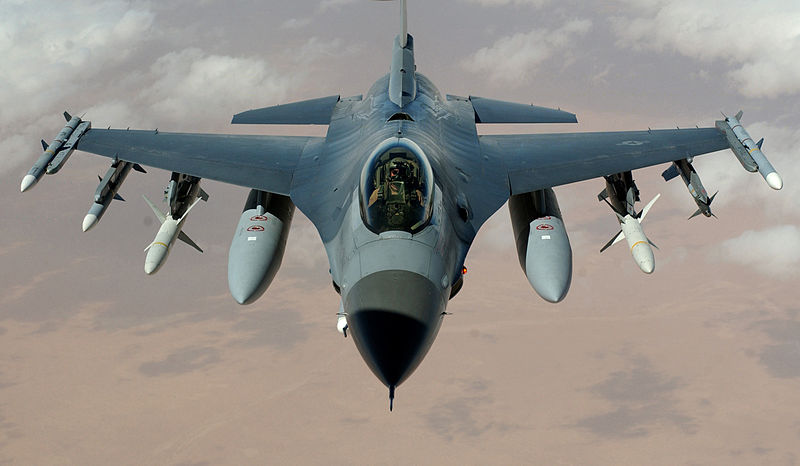
US to Upgrade Taiwan’s existing F-16 Fleet

The Obama Administration has decided to upgrade Taiwan's existing F-16 fleet

The Obama Administration has decided not to sell Taiwan the latest variant of the F-16.  Instead of being permitted to purchase the latest F-16C/D variant, Taiwan will have to be satisfied with upgrades to its current, and ageing, F-16A/B fleet.

This decision seems likely to have been prompted by a number of factors.  Firstly, and most obviously, it seems probable that decision-makers took into account China’s objections to further arms sales to what Beijing considers a rogue province.  With the US keen to build ties with China, it will have been anxious to avoid a repeat of China’s reaction to Washington’s decision to sell Apache gunships to Taipei in 2010.  Beijing cut military-to-military ties with Washington in response.

Given recent scandals concerning Chinese espionage in Taiwan, It is also likely that the White House is concerned about the possibility of Beijing gaining access to information about the latest F-16 model.  The US refusal to consider selling its latest F-35 fighter is also indicative of this concern.

The decision to upgrade Taipei’s existing F-16 fleet was probably the most palatable option for the US.  Some analysts, for example, have argued that with upgrades to the F-16A/Bs, the aircraft may be almost equivalent to the latest variant, so Taiwan gets an improved aircraft, Beijing will object less vigourously than it would to the sale of new aircraft while Washington signals its continued support for Taiwan.

There has, however, been some criticism of the decision.  Some members of Congress, such as John Cornyn (R-Tex) have objected to mere upgrades and signaled their desire to force the Administration to sell the latest variant, highlighting the importance they attach to the support of Taipei in addition to the economic benefits to the US.  Lockheed Martin, hardly, it must be admitted, a disinterested observer, estimate that sale of the latest variant could generate as much as $8.7 billion and create up to 23, 000 jobs.  It has also been claimed that without the sale of the C/D model the F-16 production line may prove to be unsustainable.

Others, looking at the wider picture, have portrayed the decision as a capitulation to Chinese pressure which will fail to reassure US allies in the Asia Pacific of Washington’s continued commitment to their security.  Despite the best efforts of Secretary of State Clinton to assert that the US is back in Asia to stay, doubts persist among Asian allies about American staying power in the region.  Witness efforts by countries as diverse as Australia, Japan, the Philippines, South Korea and even Vietnam to encourage a renewed and increased American presence in the region.  Should the US be seen to fail to support Taiwan, it may result in regional capitals drawing uncomfortable conclusions regarding Washington’s commitment to their own security.

In addition, while this upgrade will improve Taiwan’s existing F-16 fleet, it will do nothing to replace its Mirage and obsolescent F-5 aircraft, meaning that the lethality of Taiwan’s air assets will continue to deteriorate.  This stands in marked contrast to the Chinese trend of continued and rapid modernization of its air and ballistic missile forces, many of which are deployed within easy reach of Taiwan.

In conclusion, then, this decision seems to be an effort to satisfy everyone, but which satisfied no one.  US support for its allies will be called into question, Beijing will still object to the upgrades, and Taiwan does not get a new fighter with which to replace ageing aircraft and balance against China’s military build-up.


Ethnic Fighting Breaks Out in Myanmar

Fighting has broken out between the Kachin Independence Army (KIA) and government forces in northern Myanmar near the Chinese border.  Myanmar state media is reporting that the government decided to act after the KIA attacked first and refused to withdraw form an area near a hydropower plant.

The fighting is centred in Kachin State, not far from where the Datang Corporation, a Chinese state owned enterprise (SOE), is building a hydroelectric plant on the Taping river.  It has been claimed by the corporation that 90% of the energy produced will go to Chinese companies across the border.

While Myanmar’s state media is reporting that the government’s intentions are “to protect its members and an important hydropower project of the nation”, this outbreak of fighting breaks a 1994 ceasefire with the KIA which allowed it to keep its  arms.  Analysts have claimed that the government in Naypyidaw is determined to assert its authority over the rebellious state whose militias have battled the regime for decades and have lately resisted pressure to incorporate their fighters into a state-run border security force.

It is also likely that Naypyidaw is under pressure from China, its major ally, to secure the region and protect its investment.  When the fighting broke out, approximately 200 Chinese engineers and other workers were swiftly repatriated across the border.

China has extensive and increasing hydropower investments in Myanmar and they are an increasing source of instability.  For the government, they are a welcome source of revenue.  The Burma River Network, for example, has claimed that China’s investments in Kachin State is worth $3.6bn and will result in annual power sales of $500m.

For those forced to live in their shadow, however, they create resentment as they see little of the revenue created, are displaced to make way for projects and have to live with the environmental consequences.  In addition to the fighting in Kachin State, both Shan State and Karenni State have seen recent fighting, prompted by dam construction, reports the Burma Rivers Network.

The Irrawaddy, an independent Burmese newspaper based in Thailand, has reported that representatives from the Kachin Independence Organization (KIO), the political wing of the Kachin independence movement, met with representatives of the Kachin Consultative Committee, a group of Kachin loyal to the central government, to discuss the possibility of a ceasefire on Friday 17th June.

The KCC representatives stated that the government wishes to call a ceasefire.  This assertion was rejected by the KIO because, it claimed, of the delegates’ inability to produce any form of evidence to confirm the intentions of the government.

With the KIO claiming that as many as 10,000 Kachins are now fleeing from the fighting, including some 200 who have crossed the border into China, no immediate prospect of a ceasefire, and a central government that remains unsympathetic to the claims of various ethnic groups for greater autonomy, far less independence, the prospects for reconciliation seem slight.

Tensions Rise between the Philippines and China in the South China Sea: What’s in a Name?

Map of the Spratly Islands illustrating territorial claims


It seems that tensions are continuing to rise in the South China Sea.  Increasing Chinese assertiveness in the region has prompted complaints from Vietnam and the Philippines.  Vietnam has recently announced that it will carry out a live fire naval exercise in the region, a move widely seen as a response to China’s increasingly assertive posture, while there is a move in the Philippines to re-name the South China Sea.

A Filipino lawmaker, Walden Bello, has filed House Resolution 1350 calling upon the Filipino Congress to investigate the possibility of changing the name of the South China Sea to the Western Philippine Sea in an attempt to bolster Manila’s territorial claims in the region.  Such passions have been aroused by a number of clashes which have seen Chinese naval vessels harass Filipino ships around the disputed Spratly Islands.  In one of the most serious incidents, a Chinese naval vessel fire shots at Filipino fishing boats near the Jackson (Quirino) Atoll.

In addition, Manila has also claimed that China has constructed a military post near the Amy Douglas Bank, an act which could constitute a breach of the 2002 Declaration of the Code of Conduct of Parties in the South China Sea (DOC).  The DOC is a non-binding agreement between China and ASEAN which calls for restraint and the avoidance of occupation of uninhabited land.  Manila argues that this latter provision in particular has been “aggressively violated” by China.

China, for its part, argues that its sovereignty has been breached by Filipino vessels, though it is generally agreed that the clashes have taken place in waters within the Phillipines’ 200 kilometre Exclusive Economic Zone.

The problem is, of course, is how to determine ownership.  The United Nations Convention on the Law of the Sea (UNCLOS) gives a country sovereignty over seas up to 12 nautical miles (22.2 km/13.8 miles) from its coast, including of islands.  In addition, there is also a recognised 200 nautical mile Exclusive Economic Zone (EEZ).  This grants jurisdiction over natural resources found in the region, the right to conduct scientific research and to building structures. Recent incidents have been inside the EEZs of Vietnam and the Philippines.

China, however, argues that its historical sovereignty can be traced back to the 7th century and supersedes any contemporary claims to the sea, but says it is ready to cooperate with others on joint exploration.

In light of such disagreements, Manila has tried to internationalise the situation.  It has stated it intent to file an official protest over Chinese actions at the U.N. and has recently suggested that the Mutual Defence Treaty it signed with the U.S. in 1951 would be activated should any dispute with China escalate.

The U.S., however, seems less certain of this.  Its embassy in Manila stated that the “US does not take sides in regional territorial disputes”.  It outlined Washington’s concerns about recent incidents in the South China Sea and acknowledged that it shares a number of interests with the international community in the region, but refrained from mentioning the Philippines specifically, nor did it note the defence ties it shares with Manila.

This hesitation on the part of Washington has not, however, dissuaded Manila from pursuing its claims.  The Filipino military has confirmed that it refers to the South China Sea as the Western Philippine Sea, though Armed Forces spokesman Commodore Miguel Jose Rodriguez was also keen to add that other nations in the region also have their own names for the disputed waters.  Not to be outdone, the Filipino weather Bureau, Pagasa (the Philippine Atmospheric, Geophysical and Astronomical Services Administration) has announced that it, too, will henceforth refer to the region as the Western Philippine Sea.

It remains to be seen how China, and indeed other states which hold territorial claims in the South China Sea, will react to this latest move by Manila.


The 2011 Shangri-La Dialogue

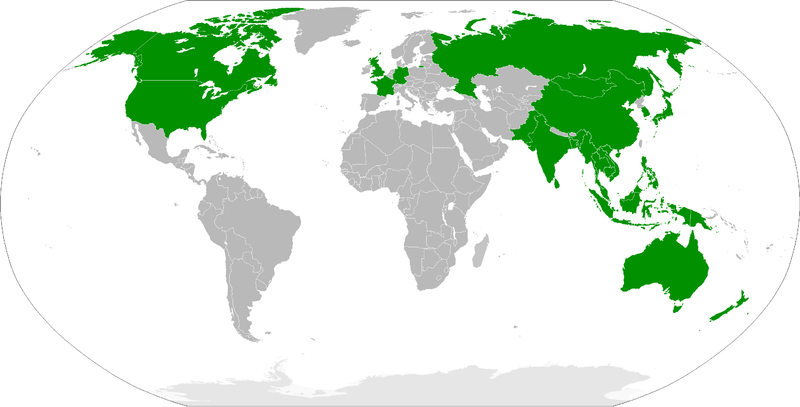
Shangri-La Dialogue member countries


June 5th saw the conclusion of the 2011 Shangri-La Dialogue.  Hosted by the International Institute for Strategic Studies in Singapore, the three day event brought together Defence Ministers and military figures from the Asia Pacific region.  What, then, were the main talking points of the weekend?

Perhaps predictably, the situation in the South China Sea dominated discussion.  Many countries, particularly Vietnam and the Philippines, are increasingly concerned by what they consider to be China’s belligerent behaviour in the region.  Vietnam points to cases of its fishing fleet being harassed by Chinese naval vessels.  More recently, May 26th saw a confrontation which allegedly ended with a Vietnamese survey ship’s seismic cables being cut by a Chinese vessel as it conducted an oil and gas exploration mission.

This dispute provoked protests in Hanoi and Ho Chi Minh City as Vietnamese expressed their anger, though it is unclear whether the protests were encouraged by the government.  While the Vietnamese government claims the survey ship was operating deep in its territorial waters and called the incident a “serious violation of Vietnam’s sovereignty”, the Chinese deflected criticism by arguing that Vietnamese oil and gas operations “undermined China’s interests and jurisdictional rights”.

This incident illustrates the potential for discord in the South China Sea, a situation exacerbated by the multitude of competing territorial claims held by such nations as China,Vietnam, the Philippines, Malaysia, Brunei and Taiwan.  The Spratly Islands, for example, are contested by all of the countries named above and are thought to be resource rich.  Ownership of the Paracel Islands, held by China, is also a matter of contention as Vietnam, which was evicted from the Islands by China in 1974, still claims ownership.

China, for its part, struck a more conciliatory note at the conference than it has been want to do when facing criticism from its maritime neighbours.  General Liang Guanglie, China’s Minister for National Defence, strongly reiterated China’s desire for a peaceful rise, stating that Beijing does “not intend to threaten any country with the modernization of our military force”. China, argued Liang, has no desire to seek hegemony in the region.  He painted China’s military budget, which is set to rise by an official 12.7% this year, as a natural improvement of its military equipment which, he highlighted, consists of “mainly second-generation weapons”.

Other countries in the region, however, remain unconvinced and continue to hedge against China’s military development, particularly its naval modernisation.  At the Dialogue, for example, the Vietnamese confirmed that their government has purchased six Russian Kilo class submarines at a cost of US$3.2 billion, Thailand is thought to be considering the purchase of second-hand submarines from Germany and even the Filipino navy, which can ill-afford such expensive platforms, is thought to be considering the pursuit of a submarine capability.

It is in the context of this burgeoning Asian arms race that Washington has been seeking to re-establish its presence in the region after years of neglect due to its adventures in the Middle East.  Robert Gates, the U.S. Secretary of Defence, spoke of his concerns regarding the possibility of a clash in the South China Sea unless all parties with an interest in the disputed waters agree on a mechanism with which to settle disputes.  Such clashes, he stated, would not serve anyone’s interests.

Reaffirming the United States’ role as the Asia Pacific’s security guarantor, he promised that the fiscal situation his country finds itself in will not affect its commitments in Asia.  Indeed, he wagered that over the next ten years the “U.S.influence in the region will be as strong or stronger”.  Assuring allies of America’s intentions, he highlighted that Washington continues to invest in stealth aircraft, drones, warships and cyber weapons.  Such capabilities, he argued, are the “most relevant to preserving the security, sovereignty, and freedom of our allies and partners in the region”.

Emphasising U.S.policy in the Asia Pacfic, he noted four “enduring principles” that should provide a framework for co-operation in the region: free commerce, the rule of law, open access to the global commons of sea, air, space “and now, cyberspace”, and peaceful conflict resolution.  The reference to cyberspace seemed particularly pointed given Google’s recent allegations about hacking attacks emanating from China.

Of the U.S.–China relationship, Gates, keen to downplay the notion that China’s rise poses a threat to the region, stated that the relationship currently enjoys “a more positive trajectory”, but remains “underdeveloped”.

In an apparent hedge against China’s increasing assertiveness, however, Gates also announced that the U.S. Navy will establish a new base in Singapore.  While Washington has maintained a facility there, the U.S.plans to permanently station one or two of its new Littoral Combat Ships in Singaporean waters, according to the Singaporean Defence Ministry.  This move is part of “a number of steps toward establishing a defence posture across the Asia-Pacific that is more geographically distributed, operationally resilient and politically sustainable,” outlined Gates.

U.S.military planners are keen to spread their forces more widely across the region in order to make it harder for an adversary to strike a knock-out blow in event of a conflict.  In addition, ongoing political troubles surrounding existing U.S.bases, such as Okinawa, makes spreading its assets around the region particularly attractive to Washington.  Indeed, noting this, some analysts in Australia, most prominently Ross Babbage, have called for U.S.troops to be based in Australia.

It would however, be a mistake to think that the situation in the South China Sea was the only issued considered at the conference.  The Japanese Minister of Defence, for example, spoke about the ongoing earthquake crisis in Japan, while Sergei Ivanov, the Russian Deputy Prime Minister, outlined the important of building strategic confidence in the region.  The Malaysian Prime Minister, Najib Razak, echoed this sentiment, highlighting the global trend toward integration and interdependence.  He also framed China’s rise as a cause for optimism rather than trepidation.

North Korea’s nuclear weapons program also merited discussion at the launch of a new book by Jonathan D. Pollack who has concluded that North Korea’s third nuclear test will probably be of a highly enriched uranium (HEU) bomb.  Depressingly, he also believes that neither China nor the United States can stop or reverse the North’s nuclear weapons program.

In conclusion, the primary focus of the Dialogue was on the possibility of future quarrels – and how to deal with them – as Asian powers with rising military budgets continue to contest often potentially resource-rich territory.  All parties agree that confidence building and co-operation is desirable.  What remains to be seen, however, is to what extent such sentiments are reflected in behaviour.  Will China continue to press its claims aggressively?  Will this drive other Asian powers toward America and will an arms race develop in the Asia Pacific as countries attempt to balance China’s rise?

Other issues also continue to exercise analysts.  The aftermath of the Japanese tsunami has crippled Tokyo.  As Prime Minister Kan attempts to bring the situation under control and begin reconstruction, he faces an uphill struggle in the wake of the recent no-confidence motion. North Korea, too, is a continuing cause for concern.  We certainly live in interesting times.


China Accused of Hacking Google Again

Google has alleged that a recent hacking attack emanated from China


Google has, once again, alleged that it has been the victim of a hacking attempt emanating from China.  The internet giant claims that it has identified an extensive electronic surveillance campaign directed against hundreds of users of its Gmail email system, including senior American and Asian officials, journalists and Chinese activists.

This echoes Google’s 2010 claim that hackers based in China attacked the company’s own systems.  This led to Google refusing to co-operate with Chinese government censorship requirements.  Both this and the latest allegations have been vehemently denied by the Chinese government which has claim that China itself is actually a victim.  A spokesman for the Chinese foreign ministry argued that blaming China for such actions is “unacceptable”.  He continued to state the Chinese government’s view that hacking “is an international problem and China is also a victim. The claims of so-called support for hacking are completely unfounded and have ulterior motives”.

Whoever was responsible for the latest phishing attacks, it seems likely that they will prompt greater security awareness among U.S. officials, who, it seems, were tricked into disclosing their password details, allowing their mail to be followed by someone in China.  The U.S. Secretary of State, Hillary Clinton, expressed her concern regarding the allegations and one assumes that several memos have been sent reminding officials to stick to their work accounts when discussing official matters.

While China has declared its innocence, analysts agree that given the sophisticated nature of the attack and the identities of those targeted, financial gain can be ruled out.  Google did not discount the possibility that the attack may have been state-sponsored.

Why, then, has China been blamed for this attack?  Firstly, and most obviously, because Google claims to have traced the attack to a school in Jinan in Shandong province.  This is not the first time that Lanxiang vocational school has been implicated in such attacks.  While its national reputation is built upon its cookery and beauty industry training, the school, which has an annual intake of 20,000 students, also boasts a large computer studies class.  Indeed, the school makes much of its 10 large computer laboratories and at one time claimed to hold a Guinness world record for the room with the most computers.

In 2010 the school was named by the New York Times as one of two schools suspected of hacking attempts against American companies and human rights activists.  The other school was the prestigious Shanghai Jiaotong University.  Raising suspicions, the NYT reported that the Lanxiang vocational school was established with military support and trains some computer scientists for the military.

This, of course, is merely circumstantial evidence at best, but the Chinese military does have some form when it comes to hacking.  It sponsors hacking competitions between teams from rival provinces.  A team representing the Sichuan Military Command, for example, was implicated in attacks on the U.S. Department of Defence in 2006.

Moreover, Chinese strategists have written at length on the necessity of pursuing asymmetric strategies.  Acknowledging that U.S. military supremacy rest upon its networked command and control resources, the PLA has focused on tactics that will allow it to mitigate such an advantage by paralyzing American networks.  The most obvious manifestation of such a strategy is the 2007 missile test which saw China use a ballistic missile to destroy a weather satellite.  This was seen as a test of China’s ability to destroy American satellites should hostilities arise.  Without access to GPS, it would be much more difficult for U.S. forces to accurately strike Chinese targets.  Hacking, too, could also potentially be used to similar effect.  Such information warfare could attack the networked U.S military at its weakest point without firing a shot.

As for this particular attack, however, it seems unlikely that the culprit will ever be definitively identified.  Analysts have highlighted that the school’s computers could have been used by a third party, such as nationalist hackers unsanctioned by the government, or even by a third country hoping to camouflage its efforts.

Online nationalists have certainly taken it upon themselves in the past to attack those they perceive to be China’s enemies.  For example, in 1999, over 7,200 attacks were launched against Taiwanese websites in response to a statement by then President Lee Teng-hui.  Attacks were also launched against U.S. government sites in the wake of the accidental missile attack on the Chinese embassy in Belgrade.  In addition, a 2000 Osaka history conference which questioned the historical veracity of the Nanjing Massacre prompted attacks against Japanese sites, including that of the Bank of Japan which suffered 1,600 strikes within seven minutes.

Whatever their source, these latest attacks come as the Pentagon seems to be considering a more muscular policy toward hacking attacks.  The Wall Street Journal has reported on the existence of a classified document which suggests that the U.S. may respond to an online attack from a foreign country with traditional military methods.  The report points to concerns regarding U.S. infrastructure such as electrical grids and nuclear reactors.  It quoted one official as stating “If you shut down our power grid, maybe we will put a missile down one of your smokestacks”.

Such a policy, of course, raises all manner of thorny issues, such as how to identify the origin of such an attack and whether accusations of an attack may be used to justify a pre-determined military action.  It also raises the danger of being seen as indecisive if a hacking attack of considerable significance is not met with a military response.  It is difficult to imagine that an attack from China, for example, would prompt a military response, even if it could be proved beyond doubt that the attack was state-sponsored.    In addition, it is not altogether obvious that the leaders in Zhongnanhai are in complete control of subordinates in distant provinces.  An attack could be sponsored by official elements without permission from the centre.

Finally, it is unlikely that China is the only country involved in such activities.  Russia, too, has been accused in the past of at least turning a blind eye to, if not sponsoring, hacking attacks, while the recent Stuxnet attack on Iran’s uranium enrichment infrastructure implicated the United States and Israel.  The British government has also set aside £650m to deal with computer security.  As part of this, the Ministry of Defence plans to recruit hundreds of experts to protect British interests as adversaries threaten the networks the British armed forces depend upon.  Indeed, claimed the Ministry, future “conflict will see cyber operations conducted in parallel with more conventional actions”.

In short, it seems safe to conclude that the internet, if not already militarised, seems set to become so.

Kim Jong-il Visits Beijing

At the time of writing, the North Korean leader, Kim Jong-il, is visiting Beijingin order to meet with Hu Jintao, the Chinese President.

While both sides typically wait until such trips have been concluded before announcing any details, it seems likely that key topics of conversation will include the DPRK’s nuclear program, food shortages, the future leadership role of Kim Jong-un and recent accusations that the North has shared missile technology with Iran.  China, incidentally, has blocked the public release of the U.N. report that makes this claim.

This meeting coincides with the visit to North Korea of U.S. Ambassador Robert King, Special Envoy for North Korean Human Rights Issues, and Jon Brause, a representative of the US Agency for International Development, which will see them investigate the DPRK’s reported food shortage and human rights situation.

While the World Food Program has warned of food shortages affecting six million North Koreans, some analysts believe that the situation is not as bad as DPRK officials have suggested and that the Kim government is attempting to stockpile food to prepare for national celebrations in 2012 to celebrate the 100th anniversary of the birth of Kim Il-sung.  The shortage has been provoked by a number of factors such as heavy rain, a particularly harsh winter and an outbreak of foot and mouth disease.

King and Brause’s trip comes in the wake of former U.S. President Jimmy Carter’s recent remarks accusing the U.S. and South Korea of a “human-rights violation” for refusing food aid.  Valerie Amos, the U.N. Undersecretary General for Humanitarian Affairs and Emergency Relief Coordinator, has also emphasised the need to base aid on humanitarian requirements, not the political situation in the country.

However, it seems unlikely that South Korea will make a donation given recent events such as the North’s attack on a South Korean warship last year followed by its shelling of Yeonpyeong Island.  In addition, South Korean President Lee Myung-bak has also taken a strong stand since winning power in 2008.  Having ended the Sunshine policy of engagement pursued by his predecessor, he will not resume aid until the North abandons its nuclear weapons programme.  The U.S. is more likely to donate food, though it would seek assurances regarding the transparency of the distribution process.

Despite the veil of secrecy obscuring the trip, we do have some idea of Kim’s activities.  Yonhap, the South Korean news agency, has reported that Kim has toured special economic zones in China in an apparent effort by the Chinese to persuade him to adopt a modicum of economic liberalisation. China, fearing a large influx of North Korean refugees should the North collapse, would welcome any policy shift that would promise greater prosperity for North Koreans.

The South Korean President, Lee Myung-bak, meanwhile, has welcomed Kim’s visit, reasoning that such trips give the reclusive North Korean leader an opportunity to learn from China’s development and that such lessons “will bring about changes”.

Any changes, however, can be expected to be gradual and tentative.  In short, no matter what announcements follow this trip, the thinking of the North Korean government is likely to remain opaque as different factions vie for influence.

Prospects for U.S. – China Military Talks

Next week will see the resumption of military to military talks between the U.S and China.  Coming in the wake of the U.S.– China Strategic and Economic Dialogue, what can we expect from this exchange?

Since the last such talks in 2009, China’s domestic and foreign posture has become more assertive.  Domestically, the Chinese government has cracked down on dissidents with renewed vigour, most notably in the sentencing of Liu Xiaobo, the 2010 Nobel Peace Prize winner, for subverting state power, and the recent detainment of the artist Ai Weiwei, ostensibly related to as yet undetailed financial crimes.  In addition, the recent inchoate online calls for a Jasmine Revolution to mirror the current turmoil in theMiddle East has spooked the CCP who fear any example of resistance to authoritarian government.

China’s foreign policy has also displayed a harsher edge.  While for some time Beijing’s diplomacy won some prestige and plaudits through its involvement with the Six Party Talks on North Korea’s nuclear weapons programme, from 2009 China began to consciously lean toward Pyonyang.  When North Korea sank the South Korean corvette, Cheonan, the Chinese refrained from criticising North Korea, alienating Seoul.  This state of affairs was only exacerbated by Beijing’s muted response to the DPRK’s shelling of Yeonpyeong Island.

This has had the twin consequences of pushing South Korea closer to the United States and, surprisingly, given Seoul’s historical grievances against Japan, has even led South Korea to investigate the possibility of a military pact with Tokyo.

Japan was also taken aback by the Chinese response to its arrest of a Chinese trawler captain whose vessel rammed a Japanese patrol boat.  Although Japan ultimately repatriated the fisherman, China’s aggressive reaction – holding up the export of rare earth minerals, demanding an apology and detaining Japanese citizens resident in China in an apparent retaliatory gesture – concentrated Japan’s mind on the possible future threat represented by China.  Such thoughts are not reassured by the continued presence of Chinese submarines in Japanese waters nor by the buzzing of a Japanese destroyer by a Chinese military helicopter off Okinawa in March.

The Philippines has also complained about the treatment one of its survey vessels received in the resource-rich South China Sea.  According to Manila, Chinese patrol ships threatened to ram the survey ship.  Vietnamese fishing boats have also been harassed by Chinese vessels.

The issue of China’s maritime actions came to a head in the summer of 2010 when the PLA claimed “indisputable sovereignty” over the South China Sea, albeit with the caveat that it would allow others to freely navigate these waters.  The suggestion that the Chinese consider the South China Sea a core interest was of considerable concern to others who claim territory in these waters.  The Vietnamese, for example, continue to claim ownership of the Paracel Island Chain, from which China evicted them in 1974.  They also differ on ownership of the Spratly Islands, while countries such as Malaysia, the Philippines and Brunei also claim ownership over parts of the sea.

Finally, the Chinese also chose to unveil and test its J-20 fighter jet during the visit of U.S. Defence Secretary Robert Gates.

The reasons behind this new assertiveness are unclear, but it seems probable that it is the result of a number of factors, such as poor co-ordination between Chinese bureaucracies, a lack of control at the very top allied to the sense, particularly in the wake of the Global Financial Crisis and the relative decline of the West vis-à-vis China, that now Beijing is strong enough to adopt a more assertive and aggressive foreign policy.

The U.S. for its part has also been active.  In 2009, Vietnamese officials were invited to visit an American aircraft carrier, the USS John C. Stennis in an apparent attempt to continue to build links withVietnam as a hedge against China.

July 2010 saw U.S. Secretary of State Hillary Clinton give a speech at the ASEAN meeting in Hanoi in which she emphasised that Washington considered any territorial disputes in the region to have global implications because of its role as a trade route and source of natural resources.  She particularly irked Beijing by suggesting that the U.S.could act as an arbiter in any such regional disputes, offering support for smaller South East Asian states anxious about the prospect of bilateral disputes with Beijing. China’s Foreign Minister, Yang Jiechi, was particularly riled by this, stating that Clinton’s words were “an attack on China” and adding, in conversation with George Yeo, the erstwhile Singaporean Foreign Affairs Minister, that “China is a big country and other countries are small countries, and that’s just a fact”.  Such remarks further alienated China’s neighbours.

Clinton followed this trip with an October tour of a number of countries around the Asia Pacific, including China, aimed at re-affirming Washington’s commitment to the region.

This, then, is the background to the resumption of talks.  While both sides are unhappy at the actions of the other, they realise that they have common interests and that their relationship is too important to neglect.  As American power declines relative to that of the Chinese, such talks will become increasingly important.  Small and middle power countries in the region will look on with interest and hope that American engagement in the region will restrain the Chinese. Beijing may look at the resumption of these talks as a way to begin to undo the suspicion that its clumsy diplomacy of the last couple of years has created amongst its neighbours. Beijing is still keen to promulgate its narrative of a harmonious rise that promises no ill to its neighbours or the wider world.  While it is unlikely that these talks will result in any radical outcomes, it is to be hoped that their resumption will lead to further development and maturation of the most important bilateral relationship in the world.