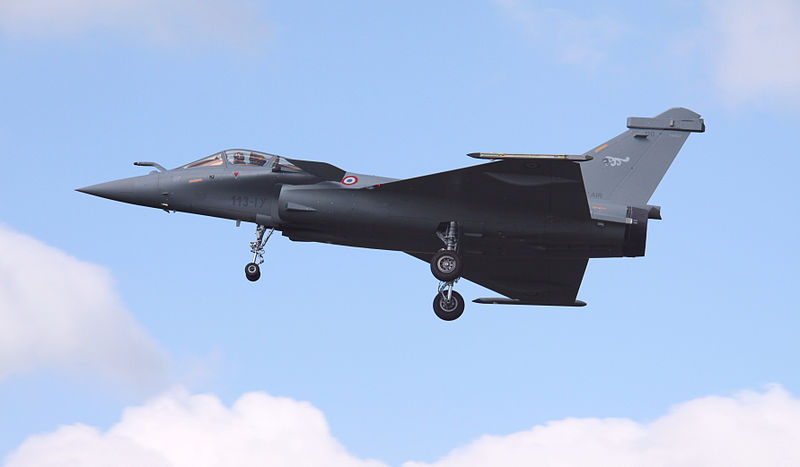
India has finally chosen th Dassault Rafale
The Dassault Rafale has emerged asIndia’s preferred fighter, beating competition from the Eurofighter Typhoon. It has also seen off rivals such as the U.S. F-16 and F-18, the Russian MiG 35, and Swedish Saab Gripen.
Dassault will now enter final negotiations aimed at concluding a deal that will see India purchase 126 Rafales, with the option of a further 63 jets. It should be noted, however, that Dassault has fallen at the final hurdle before, failing to seal deals with nations such as Morocco, Brazil and the UAE.
That said, should the deal be finalised, it will see Dassault win a major contract, with estimates of its value ranging from $11 to $20 billion. This would be extremely welcome news for Dassault which has failed to win an export market for its aircraft. Some figures in the French Defence Ministry have even questioned the wisdom of continuing government support for the firm in the absence of foreign interest in the Rafale.
From the Indian perspective, this deal makes a lot of sense. The Indian Air Force (IAF) has a long history of flying French aircraft so this purchase represents a degree of continuity. Indeed, India is also working with France to improve its naval capabilities in the shape of the Franco-Spanish Scorpène submarine.
The Rafale comes in multiple variants. The Rafale M is designed to operate from aircraft carriers and will be of particular interest to an Indian Navy aiming to develop a carrier warfare capability. In addition to this variant, the French operate a two-seat Rafale B and single-seat Rafale C, while the aircraft can also perform as a tactical nuclear bomber. This may appeal to a country which considers itself threatened by Pakistani and Chinese nuclear weapons.
Perhaps the most interesting aspect of India’s decision, however, is how swiftly it discarded the American option. Both the F-16 and F-18 failed to win India’s approval. Given Washington’s support of New Delhi’s great power ambitions and the combat-tested pedigree of these aircraft, India’s decision is somewhat surprising and will not lend itself to interoperability with U.S. forces should defence co-operation between the two countries grow. While India tested all contenders in a comprehensive evaluation process, it seems plausible that its decision was informed by its traditional desire to emphasise its strategic independence, an inclination also shared, incidentally, by Paris.
If such philosophical considerations played a role in India’s decision, it also seems likely that the prospect of benefiting from the transfer of French technology also played its part. Though France will deliver the first 18 jets off the shelf, the remaining aircraft will be manufactured in India by Hindustan Aeronautics. As India is keen to improve its indigenous defence industry, such a technology transfer will have held a great appeal.
In short,India is set to buy a capable aircraft, while France will be keen to consolidate its foothold in the world’s largest emerging defence market. The decision to purchase the Rafale also emphasises that India remains determined to follow its own course. America’s aim of supporting the rise of India as a great power to build its ability to serve as a provider of security in the Indian Ocean will be slower and more difficult than Washington would like.
 Asia Pacific Briefing