Japan and Collective Self-Defence

Japan’s cabinet has approved a reinterpretation of its constitutional restrictions on its use of armed force.  The new interpretation has cleared the way – pending parliamentary ratification – for collective self-defence, the use of force to defend not only Japan but its allies.

It’s important to note, however, that some significant caveats will remain attached to Japan’s interpretation of collective defence.  Firstly, any attack on an allied country must clearly endanger Japan’s survival or severely impinge upon Japanese citizens’ lives, liberty and pursuit of happiness.  Secondly, the use of force must be the only way to repel the attack on Japan’s ally and protect Japanese citizens.  Thirdly, any use of force must be limited to the minimum required level.

While such caveats certainly offer room for manoeuvre, this reform is not evidence of the Japanese remilitarisation that Beijing and Seoul often identify in the most routine of Japanese military decisions.

Nevertheless, the move has not been without controversy.  One man set himself alight in Tokyo in protest while others have protested more soberly.  Abroad, China has, predictably, expressed outrage while South Korea has also expressed concern.

This reform, however, is a fillip for the U.S. which has long encouraged Japan to play a greater security role in its region.  Countries such as Australia also stand to benefit from a more normal Japanese defence posture.  Canberra is interested in acquiring Japanese submarine technology, or even completed submarines.

It’s difficult to emphasise how symbolically important Tokyo’s decision is.  In the wake of the Second World War, Japan adopted the Yoshida Doctrine, named after its formidable postwar Premier, Yoshida Shigeru.  This approach, which has remained hugely influential, demands that Japan focus on economic development while maintaining the relatively lightweight Japan Self-Defence Forces (JSDF).  To ensure its security, Japan has accommodated a substantial U.S. military presence.

While some in Washington accused Tokyo of free-riding throughout the Cold War, Japan’s grand strategy was undoubtedly successful.  In the early postwar years it was feared by it neighbours, despite its impoverished circumstances.  The doctrine guided Japan through a difficult period, enriching it and nurturing its status as a solid global citizen.  Why, then, has Tokyo decided to modify its stance?

The primary reason is China.  Beijing’s impressive military modernisation, combined with its increasing willingness to assert its expansive maritime claims, has focused minds in Tokyo.  By permitting the JSDF to come to the aid of its allies, even in the absence of a direct attack on Japan, Tokyo has changed Beijing’s strategic calculus and signalled its intent to balance against China.

Tokyo’s decision also hints at its doubts about Washington’s ability to maintain its primacy in Asia.  Though the U.S. will remain the strongest power in Asia for some time, Beijing is closing the gap at an impressive rate.  China will probably never be able to establish Chinese primacy in Asia, but its ability to contest American primacy is growing.  By freeing the JSDF to come to the aid of its allies, Tokyo is supporting the U.S. primacy that has guaranteed Japanese security for decades.

Domestic politics has also played a role in this decision.  Prime Minister Shinzo Abe has driven this reinterpretation which reflects his own nationalist views.  It is easily reconciled with his desire for Japan to be a normal nation, proud of its history and able to unashamedly wield all instruments of statecraft commensurate with its economic power.

While this reinterpretation won’t change Asia’s strategic environment in the short-term, it is a significant event illustrating the danger of security dilemmas in Asia.  As Beijing has increased its military strength, inculcated anti-Japanese nationalism as a way to legitimise the Communist Party’s continued rule, and sought to expand its maritime borders in an attempt to increase its internal and external security, it has made Japan feel less secure.

This has led to Tokyo’s decision to reinterpret its constitutional restrictions on the use of force, a decision which is likely to make Beijing feel less secure and seek to increase its efforts to maximise its security.  Such a course of action will only make Japan feel even less secure, causing it to seek to increase its security, and so on.  It’s a dangerous dynamic and is likely to lead to a less stable Asia.

It’s important to note that war is not inevitable, or even particularly likely, at least in the immediate future.  The problem is that when nations begin to view their relationship in zero-sum terms, it’s difficult to step back and seek mutually beneficial compromises.  Nobody wants to have their restraint misinterpreted as weakness.

Ideally, all parties would acknowledge the concerns of others and seek to ameliorate them.  Beijing (and Seoul) should acknowledge that since 1945 Japan has been a model international citizen, instrumental in their development.  They should admit that Japan is not about to go on a rampage across Asia and has a right to provide both for its own security and the security of its allies.  Beijing should also recognise that its rapid military modernisation, opaque intentions and increasing assertiveness lead its neighbours to fear the worst about its long-term trajectory.

Tokyo, meanwhile, ought to acknowledge the impact that visits by its senior leaders to the Yasukuni Shrine have on public opinion in China and South Korea and refrain from attending.  It should also cease to equivocate on its wartime atrocities, particularly its use of Korean ‘comfort women’.

Unfortunately, as Asia tranforms from a region characterised by U.S. primacy to one in which balancing behaviour is increasingly open, recognising the legitimate grievances and rights of other parties seems to be becoming ever more difficult.

Japanese Submarines for Australia?

JS_Souryu_Class_SS_in_KOBE

A recent report has suggested that Japan may sell submarine technology or even, in what would represent a sea change in Tokyo’s defence policy, an entire fleet of vessels to Australia.  Canberra is currently considering how to replace its existing Collins class submarine and has expressed an interest in acquiring Japanese submarine technology in recent years.  If such a transfer takes places, both countries would reap some benefits.  However, it may place Canberra in an awkward position in the future should, as has been reported, Tokyo insist on some kind of formal alliance in order to seal the deal.

Firstly, from a financial perspective, a Japanese decision to sell Soryu class boats to Australia would provide a boost to its manufacturers, Mitsubishi Heavy Industries and the Kawasaki Shipbuilding Corporation.  Additional orders would also drive down the manufacturing cost, meaning that Tokyo and Canberra would have to shell out less cash to purchase future boats.

Australia would also benefit by acquiring a boat in all likelihood superior to anything that it could independently design and construct. The problems surrounding the Collins class submarine offers plentiful evidence of the challenges associated with designing and building such a complex piece of equipment.

Canberra’s attraction to the Soryu is therefore understandable.  It would obtain a proven, capable platform for substantially less than it would cost to construct an indigenously designed replacement for the Collins.  Better and cheaper?  It should be a no brainer.

From a strategic perspective, however, the decision is not so clear cut.  Reports suggest Tokyo would insist on some kind of formal alliance arrangement.  This is not unreasonable.  Both Japan and Australia are liberal democracies, share a strong economic relationship and enjoy extensive people-to-people ties.  However, though shared values may make an alliance easier to sustain, alliances are rarely founded on them.

What really matters are interests.  Australia, for example, is not straining to ally with Sweden; despite the many values both countries share, they have few common pressing interests.  In contrast, after Nixon went to China, Washington and Beijing developed a quasi-alliance, not because they shared common values, but because they had a common interest in containing the Soviet Union.

When we consider Tokyo and Canberra’s interests, the picture is a little murkier.  As Chinese power grows, Japan is casting around for all the friends it can find.  This is at the root of Shinzo Abe’s desire to strengthen Tokyo’s alliance with the U.S., loosen Japan’s constitutional restriction on the use of force, and cultivate ties with countries such as India, Vietnam, the Philippines and Australia.

This is clearly in Japan’s interests, but less clearly in Australia’s interests.  Before formally allying with Japan, Canberra should consider the possible consequences.  China and Japan are currently engaged in escalating competition in the East China Sea as they jockey for position around the Senkaku (Diaoyu to the Chinese) Islands.  While war is not imminent, it would be foolish to assume that it is impossible.  It is all too easy to envisage a scenario in which a rash decision made by a commander on the scene could lead to a clash that neither side wants but from which both may find it difficult to step back.

Should the worst happen, Japan would look to its allies for support and would expect them to honour their commitments.  If Australia was in a formal alliance with Japan, this would place Canberra in an extremely difficult decision.  Would it decide to contribute to military efforts directed against China, or would it disown its alliance with Japan?

This situation is not particularly likely, at least in the short term, but it illustrates the calculations that must be made before entering into such an arrangement with Tokyo.  Of course, Australian policymakers may decide that a decision to move closer to Japan may contribute toward deterring Beijing from upping the ante in the East China Sea.  Canberra certainly has an interest in maintaining the status quo in Asia and has no desire to see Beijing redraw maritime borders by the use, or threatened use, of force.

It is likely, however, that by moving closer to Japan, Canberra would exacerbate Beijing’s fear of containment, perhaps encouraging greater Chinese assertiveness in the future.  The Soryu would certainly boost Australia’s military capability, but any decision to acquire it must take into account the risk of getting dragged into conflicts Canberra may prefer to avoid and whether closer ties with Japan would serve Australia’s greater interest in helping to peacefully integrate China into the existing regional order.

Asia Pacific Round Up, 15/12/11

Below are a number of links to articles I have found interesting over the last week or so. Feel free to commence on them below or link to an interesting article of your own.

1. http://www.telegraph.co.uk/news/worldnews/asia/china/8954315/Inside-Wukan-the-Chinese-village-that-fought-back.html
Malcolm Moore’s excellent article for The Telegraph about Wukan, a village rebelling against local officials’ misrule.

2. http://www.taipeitimes.com/News/front/archives/2011/12/15/2003520765
Interesting story from Taiwan about the ROC’s interest in developing a its submarine capability.

3. http://www.nytimes.com/2011/12/14/sports/soccer/14iht-soccer14.html
The villagers in Wukan may not be happy with their economic prospects, but Nicolas Anelka won’t have to worry where his next baozi is coming from.

4. http://www.cfr.org/russian-fed/why-russian-protests-matter/p26773
Interesting CFR interview with Stephen Sestanovich regarding the recent anti-Putin protests in Russia.

5. http://www.bbc.co.uk/news/world-asia-16190926
China’s new aircraft carrier has been spotted in the Yellow Sea.

6. http://www.foreignaffairs.com/articles/136718/evan-a-feigenbaum/chinas-pakistan-conundrum
America isn’t the only country with a difficult relationship with Pakistan.

7. http://www.guardian.co.uk/world/2011/dec/15/deported-tamils-torture-sri-lanka?
Tamils forced to return to Sri Lanka face an uncertain future.

8. http://timesofindia.indiatimes.com/india/Anna-Hazare-wants-Parliaments-Winter-Session-extended-to-pass-Lokpal/articleshow/11117623.cms
Anna Hazare continues his fight against corruption in India.

9. http://www.atimes.com/atimes/Korea/MK08Dg01.html
Andrei Lankov on the rise of Kim Jong-eun.

10. http://www.japantimes.co.jp/text/nn20111214a3.html
The Japan Times is reporting that Japan will choose the F35 as its 5th generation fighter.

Enjoy!

The 2011 Shangri-La Dialogue

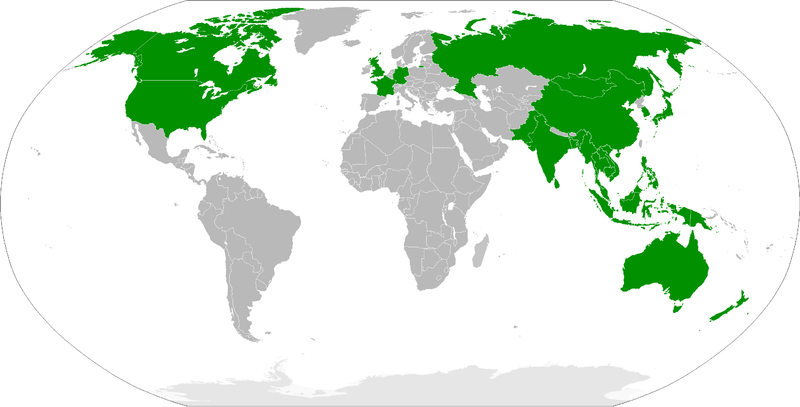
Shangri-La Dialogue member countries


June 5th saw the conclusion of the 2011 Shangri-La Dialogue.  Hosted by the International Institute for Strategic Studies in Singapore, the three day event brought together Defence Ministers and military figures from the Asia Pacific region.  What, then, were the main talking points of the weekend?

Perhaps predictably, the situation in the South China Sea dominated discussion.  Many countries, particularly Vietnam and the Philippines, are increasingly concerned by what they consider to be China’s belligerent behaviour in the region.  Vietnam points to cases of its fishing fleet being harassed by Chinese naval vessels.  More recently, May 26th saw a confrontation which allegedly ended with a Vietnamese survey ship’s seismic cables being cut by a Chinese vessel as it conducted an oil and gas exploration mission.

This dispute provoked protests in Hanoi and Ho Chi Minh City as Vietnamese expressed their anger, though it is unclear whether the protests were encouraged by the government.  While the Vietnamese government claims the survey ship was operating deep in its territorial waters and called the incident a “serious violation of Vietnam’s sovereignty”, the Chinese deflected criticism by arguing that Vietnamese oil and gas operations “undermined China’s interests and jurisdictional rights”.

This incident illustrates the potential for discord in the South China Sea, a situation exacerbated by the multitude of competing territorial claims held by such nations as China,Vietnam, the Philippines, Malaysia, Brunei and Taiwan.  The Spratly Islands, for example, are contested by all of the countries named above and are thought to be resource rich.  Ownership of the Paracel Islands, held by China, is also a matter of contention as Vietnam, which was evicted from the Islands by China in 1974, still claims ownership.

China, for its part, struck a more conciliatory note at the conference than it has been want to do when facing criticism from its maritime neighbours.  General Liang Guanglie, China’s Minister for National Defence, strongly reiterated China’s desire for a peaceful rise, stating that Beijing does “not intend to threaten any country with the modernization of our military force”. China, argued Liang, has no desire to seek hegemony in the region.  He painted China’s military budget, which is set to rise by an official 12.7% this year, as a natural improvement of its military equipment which, he highlighted, consists of “mainly second-generation weapons”.

Other countries in the region, however, remain unconvinced and continue to hedge against China’s military development, particularly its naval modernisation.  At the Dialogue, for example, the Vietnamese confirmed that their government has purchased six Russian Kilo class submarines at a cost of US$3.2 billion, Thailand is thought to be considering the purchase of second-hand submarines from Germany and even the Filipino navy, which can ill-afford such expensive platforms, is thought to be considering the pursuit of a submarine capability.

It is in the context of this burgeoning Asian arms race that Washington has been seeking to re-establish its presence in the region after years of neglect due to its adventures in the Middle East.  Robert Gates, the U.S. Secretary of Defence, spoke of his concerns regarding the possibility of a clash in the South China Sea unless all parties with an interest in the disputed waters agree on a mechanism with which to settle disputes.  Such clashes, he stated, would not serve anyone’s interests.

Reaffirming the United States’ role as the Asia Pacific’s security guarantor, he promised that the fiscal situation his country finds itself in will not affect its commitments in Asia.  Indeed, he wagered that over the next ten years the “U.S.influence in the region will be as strong or stronger”.  Assuring allies of America’s intentions, he highlighted that Washington continues to invest in stealth aircraft, drones, warships and cyber weapons.  Such capabilities, he argued, are the “most relevant to preserving the security, sovereignty, and freedom of our allies and partners in the region”.

Emphasising U.S.policy in the Asia Pacfic, he noted four “enduring principles” that should provide a framework for co-operation in the region: free commerce, the rule of law, open access to the global commons of sea, air, space “and now, cyberspace”, and peaceful conflict resolution.  The reference to cyberspace seemed particularly pointed given Google’s recent allegations about hacking attacks emanating from China.

Of the U.S.–China relationship, Gates, keen to downplay the notion that China’s rise poses a threat to the region, stated that the relationship currently enjoys “a more positive trajectory”, but remains “underdeveloped”.

In an apparent hedge against China’s increasing assertiveness, however, Gates also announced that the U.S. Navy will establish a new base in Singapore.  While Washington has maintained a facility there, the U.S.plans to permanently station one or two of its new Littoral Combat Ships in Singaporean waters, according to the Singaporean Defence Ministry.  This move is part of “a number of steps toward establishing a defence posture across the Asia-Pacific that is more geographically distributed, operationally resilient and politically sustainable,” outlined Gates.

U.S.military planners are keen to spread their forces more widely across the region in order to make it harder for an adversary to strike a knock-out blow in event of a conflict.  In addition, ongoing political troubles surrounding existing U.S.bases, such as Okinawa, makes spreading its assets around the region particularly attractive to Washington.  Indeed, noting this, some analysts in Australia, most prominently Ross Babbage, have called for U.S.troops to be based in Australia.

It would however, be a mistake to think that the situation in the South China Sea was the only issued considered at the conference.  The Japanese Minister of Defence, for example, spoke about the ongoing earthquake crisis in Japan, while Sergei Ivanov, the Russian Deputy Prime Minister, outlined the important of building strategic confidence in the region.  The Malaysian Prime Minister, Najib Razak, echoed this sentiment, highlighting the global trend toward integration and interdependence.  He also framed China’s rise as a cause for optimism rather than trepidation.

North Korea’s nuclear weapons program also merited discussion at the launch of a new book by Jonathan D. Pollack who has concluded that North Korea’s third nuclear test will probably be of a highly enriched uranium (HEU) bomb.  Depressingly, he also believes that neither China nor the United States can stop or reverse the North’s nuclear weapons program.

In conclusion, the primary focus of the Dialogue was on the possibility of future quarrels – and how to deal with them – as Asian powers with rising military budgets continue to contest often potentially resource-rich territory.  All parties agree that confidence building and co-operation is desirable.  What remains to be seen, however, is to what extent such sentiments are reflected in behaviour.  Will China continue to press its claims aggressively?  Will this drive other Asian powers toward America and will an arms race develop in the Asia Pacific as countries attempt to balance China’s rise?

Other issues also continue to exercise analysts.  The aftermath of the Japanese tsunami has crippled Tokyo.  As Prime Minister Kan attempts to bring the situation under control and begin reconstruction, he faces an uphill struggle in the wake of the recent no-confidence motion. North Korea, too, is a continuing cause for concern.  We certainly live in interesting times.


Naoto Kan Survives No-Confidence Motion

Naoto Kan, the Japanese Prime Minister, has survived a no-confidence motion.  The challenge was launched by MPs critical of his response to the recent tsunami and nuclear crises.  However, while he has survived this test, he has been left a weakened figure, particularly as the motion was supported by elements within his own party, led by Ichiro Ozawa, who, along with 50 of his supporters, abstained from the vote having earlier threatened to side with the opposition.

Indeed, Kan seems to have conceded that he will leave office.  Before the motion was debated, he announced to his party that he intends to step down after the current crisis is brought under control.  This seems to have satisfied his party, at least for the moment.  He has survived opposition attempts to force him from office in the past.

The main opposition party, the Liberal Democratic Party (LDP) led the attack but was supported by the New Komeito party and the Sunrise Party.  Sadakazu Tanigaki, the leader of the LDP criticised Kan bluntly, stating that “You have no personal virtues or ability to unite your own party members. I’m telling you to quit.”  He also outlined his belief that with Kan’s departure, “there will be many ways for us to unite, to revitalise Japan beyond party lines.”

Kan seemed to acknowledge the necessity of revitalising Japanese politics when he told his own party that “I would like for the younger generation to take over various responsibilities once I fulfil certain roles that I need to, as I work on handling the disaster.”

However, while Kan has survived this motion, comfortably winning by 293 votes to 152, he remains unpopular among the public.  A poll run by the Pew Research Center found that 79% of the 700 Japanese they surveyed rated Kan’s handling of the crisis as “poor”.  This contrasts sharply with the International Atomic Energy Agency’s assessment of the Japanese response, which it believes has been exemplary.

In his attempt to stabilise the situation,Kan faces an uphill battle to agree emergency budgets in a hostile parliament.  He can also expect controversial tax increases to be keenly contested.

Such divisions are particularly unhelpful as Japan faces up to the massive cost of reconstruction which has been estimated by some to cost over US$200 billion.  An unstable political situation is likely to drag down stock prices and complicate reconstruction efforts.

Japan May Drop the F-35

F35

Japan may drop the F-35 as its next fighter

Due to a combination of delays, rumoured poorer than expected performance and an ever-increasing price tag, it has been reported that Japan is considering dropping the F-35 as its next-generation fighter.

The most likely alternative is said to be the F/A-18 Super Hornet.  The Eurofighter was also under consideration as of April, but was thought to be the third choice because Japan’s Self Defence Forces prize co-operation and co-ordination with the U.S. military.

Japan had earlier expressed its interest in acquiring the F-22 Raptor, but such hopes were frustrated by the export ban placed on the jet and its subsequent cancellation on cost grounds.

The final decision is expected to be announced toward the end of 2011 and will see Japan replace its existing F-15s and F-4s.  The F/A-18 Super Hornet would certainly be a cheaper – and combat tested – option than the F-35 which has seen its unit cost balloon to $122 million, roughly double the 2001 estimated price.

In addition, what this means for Japan’s indigenous Shinshin (Spirit) fighter remains unclear.  Originally conceived as a back-up to the purchase of the F-22, the Shinshin project took on greater urgency following the F-22 export ban. Since 2009, Japan has invested US$500 million in its development, though some reports have suggested that, in the wake of the tsunami, expensive military procurement programmes may be one area considered ripe for cuts by Japanese politicians.  Given that the Japanese Defence Ministry has estimated that the cost of the project will run to US$100 billion – compared to the US$60 billion Raptor project – such an outcome is extremely feasible.

It should, however, be noted that Japan traditionally pays more for its self-developed military equipment due to high material costs and small production figures given Japanese regulations prohibiting arms exports. Such factors conspire to ensure that Japan typically pays at least twice as much as the U.S for weapons systems.

While the Shinshin could give the Japanese air force an edge over such regional competitors as Russian and, in particular, China, off the shelf U.S. designed jets such as the moderately stealthy F-15 Silent Eagle or Super Hornet would most likely ensure continued parity for the foreseeable future.