An increased U.S. presence in the Philippines is on the cards

A proposed deal with the Philippes may see the U.S. Navy operating ships from that country

The Washington Post has reported that U.S. and Filipino officials are in the early stages of negotiating a deal that would see an expansion of Washington’s military presence in the Philippines.

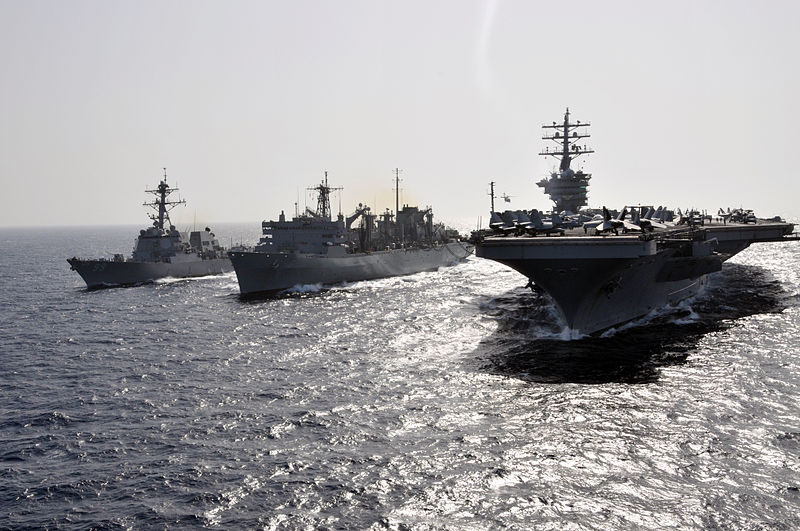
Though the U.S. has stationed a small number of special forces troops in the country to assist Manila’s efforts to combat Islamist rebels, this deal, if successfully concluded, could allow the U.S. Navy to operate ships from the Philippines and rotate troops through bases there in addition to staging joint exercises.  Washington used to operate from a large base in the Philippines’ Subic Bay but left in 1992 when Manila decided not to renew the basing agreement.

This proposed new arrangement reflects increasing Filipino concern regarding assertive Chinese behavior in the South China Sea (which Manila has taken to naming the West Philippine Sea in an effort to bolster its own territorial claims).  It would also dovetail with the Obama administration’s pivot toward the Asia Pacific which has seen, for example, moves to station Littoral Combat Ships in Singapore and a deal with Australia increasing military co-operation between the U.S. military and Australian Defence Force.

A deal would serve U.S. efforts to disperse its forces in the Asia Pacific theatre, making them less vulnerable to attack in the early stages of any conflict with China.  An increased U.S. Navy presence in South East Asia would be key to any strategy of choking Chinese supply routes through the South China Sea and Straits of Malacca.

If these early negotiations are successful, further meetings will be held in March.  As such an arrangement would be in the stated interests of both states, it seems likely that some kind of agreement will be reached.

All Tied Up in Red Tape

All tied up

Those of us who have lived, worked and travelled in Asia will be familiar with the bewildering bureaucratic hurdles to be negotiated.  While living in China, for example, I particularly enjoyed the occasional visits from my local friendly PSB officer who would pop in for a cup of tea, check that I was still living there and then wander off to parts unknown.

According to the Hong Kong based Political and Economic Risk Consultancy, however, China has nothing on India when it comes to bureaucracy.  The firm has surveyed over 1,300 executives in Asia in order to rank countries in the region.  The ranking is on a 10 point scale, with 10 being the worst possible score.  India scored 9.21, suggesting that it is the most bureaucratic country in Asia.  China, while no stranger to red tape, placed fifth with a score of 7.11.

This will doubtless be to the chagrin of India’s leaders who are seeking to compete with Beijing in all fields, including economically.  To India’s credit, it continues to post strong economic growth figures, but this report suggests that its impressive economic performance is in spite of the bureaucratic system, not because of the environment it creates.

The report links bureaucracy to corruption and in a country in which it is impossible to achieve anything without the assistance of officials, this is no surprise.  Such bureaucracy and corruption smothers the economy and prevents it from competing with China as strongly as it could.

At the other end of the scale, Singapore was rated least bureaucratic with a low score of 2.5, reflecting the enviable reputation that state’s civil service enjoys.

The full list is as follows:

India (9.21)
Vietnam (8.54)
Indonesia (8.37)
Philippines (7.57)
China (7.11)
Malaysia (5.89)
South Korea (5.87)
Japan (5.77)
Taiwan (5.57)
Thailand (5.25)
Hong Kong (3.53)
Singapore (2.25)

Key Trends in 2012

As we reflect on 2011, it is obvious that it was a year of geopolitical flux, reflected most clearly in the so-called Arab Spring. Asia, however, was also an exciting arena.

The US pivoted its focus from its wars in the Middle East to the increasing challenge posed by China to Washington’s primacy in the Asia Pacific, while December saw the death of Kim Jong Il in North Korea and the succession of his son, Kim Jong Un. Speaking of leadership changes, Vladimir Putin announced that he would seek to return to his former presidential office, while another newly appointed president in Myanmar, Thein Sein, to the surprise of commentators, appeared to open the door to cautious liberalisation.

What, then, can we expect to be the key trends in 2012? While predicting the future is, to paraphrase Hillary Clinton, a fool’s errand, here are a number of issues to keep an eye on in 2012.

1. Look for China to reign in its recent belligerence and return to the smarter diplomacy it pursued up until around 2008. Recent assertiveness has alienated its neighbours and driven them into the welcoming arms of Washington. A diplomatic approach that focuses on building economic links and reassuring neighbours that it does not seek to dominate will be more fruitful that making outrageous claims of sovereignty.

2. Events in Myanmar this year will be telling. Will Aung San Suu Kyi be permitted to compete in fair elections? If she wins, will the result be honoured? How the administration of Thein Sein reacts will indicate how serious the government is about liberalising. A genuine opposition in parliament would be a significant step forward.

3. The U.S. also faces an important year. Look for Romney to win the Republican nomination. After that, all bets are off. Nevertheless, regardless of whether Obama or Romney wins, it is clear that we are now at the end of the post 9/11 age. The U.S. will focus on Asia and strengthening its primacy vis-à-vis China after its costly misadventures in the Middle East.

4. North Korea will continue to occupy the minds of policy makers. As always with the DPRK, there are more questions than answers. Will Kim Jong Un be supported by those around him? Will he be deposed or will he secure his own position? Will Pyongyang continue the belligerent approach highlighted by the sinking of the Cheonan and shelling of Yeonpyeong Island, or will it surprise everyone by tackling internal reform as China did under Deng Xiaoping?

5. The 18th National Congress of the Chinese Communist Party in 2012 will see a major leadership turnover. Hu Jintao, Wen Jiabao, and Wu Bangguo are all expected to retire, opening the way for the Politburo and its Standing Committee to welcome a large number of new faces. How will these new leaders handle an ever more complex society and what kind of foreign policy will they pursue?

6. Will Indonesia continue to consolidate its democracy or will it falter? Corruption allegations will continue to dismay Indonesians and shape their opinion of politics, while politicians on all sides seem to lack an appetite for reforms that could help Indonesia achieve its considerable potential.

7. How will U.S. and European financial travails affect Asia? The region will also suffer an economic slowdown, but ‘suffer’ may be the wrong word; after all, Beijing’s latest Five Year Plan aims to slow growth. Nevertheless, for a country that continues to rely on exports, continued economic trouble in the West will be a cause for significant concern. As China slows, neighbours such as South Korea and Japan will also suffer. An increase in protectionist sentiment, particularly in the U.S., will lead to much complaining and anti-dumping suits between Washington and Beijing.

8. Expect the balancing of security and economics in the Asia Pacific to become ever more precarious. Most states rely upon the U.S. for their security, while depending upon China for their economic prosperity. Though security typically trumps economics, no one wants to have to pick a side.

9. India can expect further growth, albeit of a slower nature, while its politicians will continue to be cautious, except when pursuing private business interests. Significant and much needed reform is unlikely to be embraced. Growth remains fuelled by domestic demand. A focus on increasing exports would be a significant source of growth and is likely to be pursued. Kashmir will continue to be a problem, but relations with Pakistan may improve, albeit glacially.
Asia Pacific Round Up, 15/12/11

Below are a number of links to articles I have found interesting over the last week or so. Feel free to commence on them below or link to an interesting article of your own.

1. http://www.telegraph.co.uk/news/worldnews/asia/china/8954315/Inside-Wukan-the-Chinese-village-that-fought-back.html
Malcolm Moore’s excellent article for The Telegraph about Wukan, a village rebelling against local officials’ misrule.

2. http://www.taipeitimes.com/News/front/archives/2011/12/15/2003520765
Interesting story from Taiwan about the ROC’s interest in developing a its submarine capability.

3. http://www.nytimes.com/2011/12/14/sports/soccer/14iht-soccer14.html
The villagers in Wukan may not be happy with their economic prospects, but Nicolas Anelka won’t have to worry where his next baozi is coming from.

4. http://www.cfr.org/russian-fed/why-russian-protests-matter/p26773
Interesting CFR interview with Stephen Sestanovich regarding the recent anti-Putin protests in Russia.

5. http://www.bbc.co.uk/news/world-asia-16190926
China’s new aircraft carrier has been spotted in the Yellow Sea.

6. http://www.foreignaffairs.com/articles/136718/evan-a-feigenbaum/chinas-pakistan-conundrum
America isn’t the only country with a difficult relationship with Pakistan.

7. http://www.guardian.co.uk/world/2011/dec/15/deported-tamils-torture-sri-lanka?
Tamils forced to return to Sri Lanka face an uncertain future.

8. http://timesofindia.indiatimes.com/india/Anna-Hazare-wants-Parliaments-Winter-Session-extended-to-pass-Lokpal/articleshow/11117623.cms
Anna Hazare continues his fight against corruption in India.

9. http://www.atimes.com/atimes/Korea/MK08Dg01.html
Andrei Lankov on the rise of Kim Jong-eun.

10. http://www.japantimes.co.jp/text/nn20111214a3.html
The Japan Times is reporting that Japan will choose the F35 as its 5th generation fighter.

Enjoy!