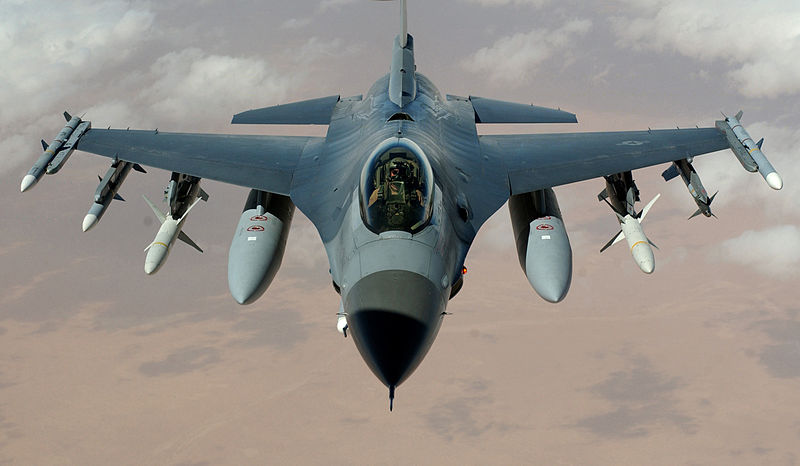
The Obama Administration has decided not to sell Taiwan the latest variant of the F-16. Instead of being permitted to purchase the latest F-16C/D variant, Taiwan will have to be satisfied with upgrades to its current, and ageing, F-16A/B fleet.
This decision seems likely to have been prompted by a number of factors. Firstly, and most obviously, it seems probable that decision-makers took into account China’s objections to further arms sales to what Beijing considers a rogue province. With the US keen to build ties with China, it will have been anxious to avoid a repeat of China’s reaction to Washington’s decision to sell Apache gunships to Taipei in 2010. Beijing cut military-to-military ties with Washington in response.
Given recent scandals concerning Chinese espionage in Taiwan, It is also likely that the White House is concerned about the possibility of Beijing gaining access to information about the latest F-16 model. The US refusal to consider selling its latest F-35 fighter is also indicative of this concern.
The decision to upgrade Taipei’s existing F-16 fleet was probably the most palatable option for the US. Some analysts, for example, have argued that with upgrades to the F-16A/Bs, the aircraft may be almost equivalent to the latest variant, so Taiwan gets an improved aircraft, Beijing will object less vigourously than it would to the sale of new aircraft while Washington signals its continued support for Taiwan.
There has, however, been some criticism of the decision. Some members of Congress, such as John Cornyn (R-Tex) have objected to mere upgrades and signaled their desire to force the Administration to sell the latest variant, highlighting the importance they attach to the support of Taipei in addition to the economic benefits to the US. Lockheed Martin, hardly, it must be admitted, a disinterested observer, estimate that sale of the latest variant could generate as much as $8.7 billion and create up to 23, 000 jobs. It has also been claimed that without the sale of the C/D model the F-16 production line may prove to be unsustainable.
Others, looking at the wider picture, have portrayed the decision as a capitulation to Chinese pressure which will fail to reassure US allies in the Asia Pacific of Washington’s continued commitment to their security. Despite the best efforts of Secretary of State Clinton to assert that the US is back in Asia to stay, doubts persist among Asian allies about American staying power in the region. Witness efforts by countries as diverse as Australia, Japan, the Philippines, South Korea and even Vietnam to encourage a renewed and increased American presence in the region. Should the US be seen to fail to support Taiwan, it may result in regional capitals drawing uncomfortable conclusions regarding Washington’s commitment to their own security.
In addition, while this upgrade will improve Taiwan’s existing F-16 fleet, it will do nothing to replace its Mirage and obsolescent F-5 aircraft, meaning that the lethality of Taiwan’s air assets will continue to deteriorate. This stands in marked contrast to the Chinese trend of continued and rapid modernization of its air and ballistic missile forces, many of which are deployed within easy reach of Taiwan.
In conclusion, then, this decision seems to be an effort to satisfy everyone, but which satisfied no one. US support for its allies will be called into question, Beijing will still object to the upgrades, and Taiwan does not get a new fighter with which to replace ageing aircraft and balance against China’s military build-up.
 Asia Pacific Briefing