
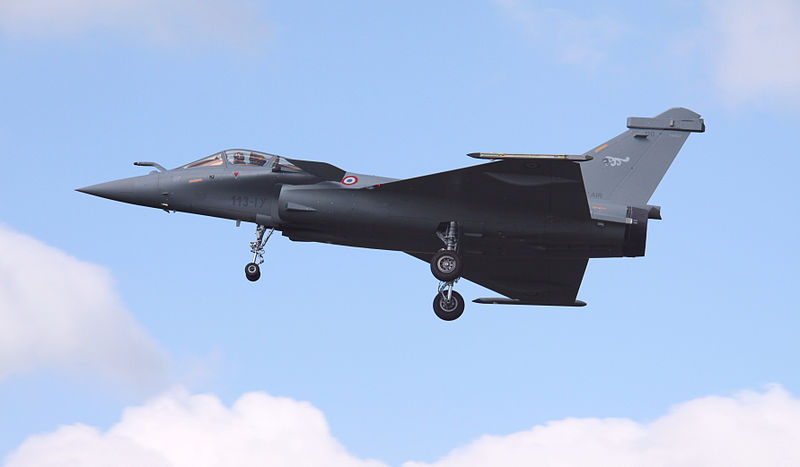
India Chooses the Rafale

India has finally chosen th Dassault Rafale


The Dassault Rafale has emerged asIndia’s preferred fighter, beating competition from the Eurofighter Typhoon.  It has also seen off rivals such as the U.S. F-16 and F-18, the Russian MiG 35, and Swedish Saab Gripen.

Dassault will now enter final negotiations aimed at concluding a deal that will see India purchase 126 Rafales, with the option of a further 63 jets.  It should be noted, however, that Dassault has fallen at the final hurdle before, failing to seal deals with nations such as Morocco, Brazil and the UAE.

That said, should the deal be finalised, it will see Dassault win a major contract, with estimates of its value ranging from $11 to $20 billion.  This would be extremely welcome news for Dassault which has failed to win an export market for its aircraft.  Some figures in the French Defence Ministry have even questioned the wisdom of continuing government support for the firm in the absence of foreign interest in the Rafale.

From the Indian perspective, this deal makes a lot of sense.  The Indian Air Force (IAF) has a long history of flying French aircraft so this purchase represents a degree of continuity.  Indeed, India is also working with France to improve its naval capabilities in the shape of the Franco-Spanish Scorpène submarine.

The Rafale comes in multiple variants.  The Rafale M is designed to operate from aircraft carriers and will be of particular interest to an Indian Navy aiming to develop a carrier warfare capability.  In addition to this variant, the French operate a two-seat Rafale B and single-seat Rafale C, while the aircraft can also perform as a tactical nuclear bomber.  This may appeal to a country which considers itself threatened by Pakistani and Chinese nuclear weapons.

Perhaps the most interesting aspect of India’s decision, however, is how swiftly it discarded the American option.  Both the F-16 and F-18 failed to win India’s approval.  Given Washington’s support of New Delhi’s great power ambitions and the combat-tested pedigree of these aircraft, India’s decision is somewhat surprising and will not lend itself to interoperability with U.S. forces should defence co-operation between the two countries grow.  While India tested all contenders in a comprehensive evaluation process, it seems plausible that its decision was informed by its traditional desire to emphasise its strategic independence, an inclination also shared, incidentally, by Paris.

If such philosophical considerations played a role in India’s decision, it also seems likely that the prospect of benefiting from the transfer of French technology also played its part.  Though France will deliver the first 18 jets off the shelf, the remaining aircraft will be manufactured in India by Hindustan Aeronautics.  As India is keen to improve its indigenous defence industry, such a technology transfer will have held a great appeal.

In short,India is set to buy a capable aircraft, while France will be keen to consolidate its foothold in the world’s largest emerging defence market.  The decision to purchase the Rafale also emphasises that India remains determined to follow its own course.  America’s aim of supporting the rise of India as a great power to build its ability to serve as a provider of security in the Indian Ocean will be slower and more difficult than Washington would like.


Key Trends in 2012

As we reflect on 2011, it is obvious that it was a year of geopolitical flux, reflected most clearly in the so-called Arab Spring. Asia, however, was also an exciting arena.

The US pivoted its focus from its wars in the Middle East to the increasing challenge posed by China to Washington’s primacy in the Asia Pacific, while December saw the death of Kim Jong Il in North Korea and the succession of his son, Kim Jong Un. Speaking of leadership changes, Vladimir Putin announced that he would seek to return to his former presidential office, while another newly appointed president in Myanmar, Thein Sein, to the surprise of commentators, appeared to open the door to cautious liberalisation.

What, then, can we expect to be the key trends in 2012? While predicting the future is, to paraphrase Hillary Clinton, a fool’s errand, here are a number of issues to keep an eye on in 2012.

1. Look for China to reign in its recent belligerence and return to the smarter diplomacy it pursued up until around 2008. Recent assertiveness has alienated its neighbours and driven them into the welcoming arms of Washington. A diplomatic approach that focuses on building economic links and reassuring neighbours that it does not seek to dominate will be more fruitful that making outrageous claims of sovereignty.

2. Events in Myanmar this year will be telling. Will Aung San Suu Kyi be permitted to compete in fair elections? If she wins, will the result be honoured? How the administration of Thein Sein reacts will indicate how serious the government is about liberalising. A genuine opposition in parliament would be a significant step forward.

3. The U.S. also faces an important year. Look for Romney to win the Republican nomination. After that, all bets are off. Nevertheless, regardless of whether Obama or Romney wins, it is clear that we are now at the end of the post 9/11 age. The U.S. will focus on Asia and strengthening its primacy vis-à-vis China after its costly misadventures in the Middle East.

4. North Korea will continue to occupy the minds of policy makers. As always with the DPRK, there are more questions than answers. Will Kim Jong Un be supported by those around him? Will he be deposed or will he secure his own position? Will Pyongyang continue the belligerent approach highlighted by the sinking of the Cheonan and shelling of Yeonpyeong Island, or will it surprise everyone by tackling internal reform as China did under Deng Xiaoping?

5. The 18th National Congress of the Chinese Communist Party in 2012 will see a major leadership turnover. Hu Jintao, Wen Jiabao, and Wu Bangguo are all expected to retire, opening the way for the Politburo and its Standing Committee to welcome a large number of new faces. How will these new leaders handle an ever more complex society and what kind of foreign policy will they pursue?

6. Will Indonesia continue to consolidate its democracy or will it falter? Corruption allegations will continue to dismay Indonesians and shape their opinion of politics, while politicians on all sides seem to lack an appetite for reforms that could help Indonesia achieve its considerable potential.

7. How will U.S. and European financial travails affect Asia? The region will also suffer an economic slowdown, but ‘suffer’ may be the wrong word; after all, Beijing’s latest Five Year Plan aims to slow growth. Nevertheless, for a country that continues to rely on exports, continued economic trouble in the West will be a cause for significant concern. As China slows, neighbours such as South Korea and Japan will also suffer. An increase in protectionist sentiment, particularly in the U.S., will lead to much complaining and anti-dumping suits between Washington and Beijing.

8. Expect the balancing of security and economics in the Asia Pacific to become ever more precarious. Most states rely upon the U.S. for their security, while depending upon China for their economic prosperity. Though security typically trumps economics, no one wants to have to pick a side.

9. India can expect further growth, albeit of a slower nature, while its politicians will continue to be cautious, except when pursuing private business interests. Significant and much needed reform is unlikely to be embraced. Growth remains fuelled by domestic demand. A focus on increasing exports would be a significant source of growth and is likely to be pursued. Kashmir will continue to be a problem, but relations with Pakistan may improve, albeit glacially.

A Declicate Balancing Act

We stand, in the words of Coral Bell, at the end of the Vasco da Gama era, having witnessed the apogee of Western domination over the international system.  For the first time in the modern era, Asia is taking its place alongside North America and Europe as a major centre of wealth, power and political weight.

A key driver of this re-emergence is the rise of China which has led scholars to consider the consequences for Asia’s strategic order.  Power is shifting East, goes the argument; power relativities are in flux. America, for so long the greatest power in Asia, will find its primacy to be increasingly unsustainable.

Inspired by the 19th century Concert of Europe, some commentators, seeking to mitigate the kind of conflict that has historically haunted power transitions, have suggested that Washington should surrender its primacy and instead embrace a system that would see it wield power in concert with the other great powers of Asia.  By sharing power with China, they argue, America could allow Beijing to maximise its power peacefully.

It seems obvious, however, that instead of the emergence of a concert of power, what is actually developing is an old-fashioned balance of power.

A balance of power creates order through the competition of major powers as each strives to improve its own position and prevent another from dominating. This balance restrains states’ behaviour as they realise that threats to the equilibrium will be met with balancing behaviour from other powers.  Such a balance seems to be emerging.

Firstly, at the recent APEC meeting, Washington signalled its determination to develop a Trans-Pacific Partnership, a free-trade area that could eclipse the European market.  While the U.S. is keen to avoid the perception that it is marginalising Beijing, it has also made it clear that Chinese participation would depend upon further economic reforms of a nature unappealing to the leaders ensconced in Zhongnanhai.

This renewed focus on economic ties with Asia reflects Washington’s concern that the Asia Pacific is become more Asian to the detriment of U.S. interests.  With most countries in the region enjoying stronger trade relations with China than the U.S., Washington is concerned that some of its allies and partners may find themselves aligning with Beijing in the future.

Secondly, Obama’s visit to Australia can also be seen in this light.  It is a response to Chinese military modernisation and the resulting vulnerability of U.S.bases in Okinawa and Guam.  It is also a way of strengthening ties with a key U.S. regional ally, one in which some voices have called upon Canberra to distance itself from the U.S. as China rises.

Furthermore, as China’s rise is perceived to threaten US primacy, other countries are already engaged in external and internal balancing. Japan, for example, is strengthening its alliance with Washington, while Australia’s 2009 Defence White Paper called for an expansion of Australia’s naval capabilities.  Seoul, meanwhile, is following a similar path of naval modernisation.

China has also been active, notably as a founding member of the Shanghai Co-operation Organisation, but has also focused on cultivating ties with Laos and competing with India for influence in Myanmar.

New Delhi itself is emerging as a key player, being courted by Washington as a potential balancer of China.  New Delhi, however, reflecting its desire to maintain strategic independence, is charting its own path, competing for influence in Myanmar and developing ties with Vietnam, a move that is welcome in Hanoi given its own concerns about China.  Moscow, though it has adopted a relatively passive posture, continues to be a major armaments and energy supplier to the region while its own conventional and nuclear arsenal bestows significant weight.  In short balancing is endemic in the region.

Finally, Australian Prime Minister Julia Gillard’s new-found determination to sell uranium to New Delhi is further evidence that a balance of power is being constructed.  Canberra’s refusal to sell uranium to India has been a significant source of tension in the relationship between the two countries.  Removing this obstacle to closer ties is a move that will allow a closer security relationship, such as that outlined in the AUSMIN 2011 Communique, to develop.

A balance of power model is not without its disadvantages.  Alliances would be temporary attempts to preserve the balance.  This raises the risk of miscalculation.  As Friedberg notes, “balance-of-power politics are seldom pretty, and they can be dangerous.”  World War One provides ample evidence of this.  Nevertheless, with skillful diplomacy and trust building measures, a balance of power would be able to mitigate competition and prevent it from heading inexorably towards strategic instability.  As US primacy fades, this may be the best Asia can hope for.

AUSMIN 2011 Analysis

AUSMIN 2011 - 60th Anniversary of the ANZUS Alliance


The 2011 Ausmin meeting has recently concluded in San Francisco, marking the 60th anniversary of the ANZUS Treaty, signed in the same city.  Details regarding basing rights are still being negotiated so the nature and extent of any future US deployment is uncertain, but it seems apparent that the US military will increase its footprint in Australia.

While the Australian side was keen to portray greater US access to Australian facilities as a continuation of the current situation, highlighting that US forces have enjoyed access for decades and that the strengthening of the relationship should pose no difficulties for China or any other Asia Pacific nation, US representatives were more forthright.  Leon Panetta, the US Defence Secretary, stated that a strengthened relationship would send a clear signal in the Asia Pacific region to “those who would threaten us”.

It goes without saying that this is directed at China.  The US is keen to spread its forces more widely across the region to make it harder for China to hit them in the opening stages of any conflict and reassure its allies of its continuing commitment and ability to defend them.  To this end, the US is taking steps such as upgrading its base on Guam, stationing littoral combat ships in Singapore, and, potentially, increasing its forces on the Australian mainland.

Nevertheless, the 2011 communiqué remains balanced, calling for partnership with China, emphasising common interests and calling for military to military communication in order to prevent misunderstanding. Despite this stated desire to build bridges with China, the communiqué makes some pointed remarks concerning the South China Sea, a region in which Chinese assertiveness has raised concerns among other claimants, particularly Vietnam and the Philippines.  Asserting both the US’ and Australia’s national interest in freedom of navigation through the South China Sea, they oppose any attempt by one party to coerce or force another to accept its claims.  ‘Oppose’ is a particularly strong word, certainly more forthright than another word that might have been used in its place, such as condemn or reject, and it seems unlikely that it was chosen lightly.

The communiqué also mentions other countries.  It outlines support for increased training and interoperability between US, Australian, South Korean and Japanese forces to combat the threat posed to all by North Korea.  India, too, is highlighted as a potential partner.  The communiqué calls upon the US, Australia and India to identify areas in which they can co-operate such as maritime security, disaster relief and regional architecture.  India’s reaction to this call will be interesting.  It has its own concerns regarding Chinese intentions in the Indian Ocean, but, despite the best efforts of the US, has been reluctant to align itself with the West, preferring to preserve what it calls its strategic independence.  In addition, Australia’s refusal to sell uranium to India is an enduring obstruction to improved co-operation between Canberra and New Delhi.

The meetings also considered appropriate responses to future online attacks, of which China is believed to be a major source. It has been agreed that a future cyber warfare attack will activate the ANZUS Treaty, reflecting previous US suggestions that an online attack may result in a very real-world military retaliation.

In conclusion, then, the outcome of the 2011 Ausmin meeting has been a continuation of current trends.  The US is keen to distribute its forces more widely across the Asia Pacific region and to reassure its allies of its continuing commitment to the region, while Australia is keen to encourage a strengthened US presence and commitment to the region as a hedge against China’s rise.  While the exact nature of the US military’s future presence in Australia has yet to be agreed, it seems likely that it will represent a strengthened American commitment to the Asia Pacific.