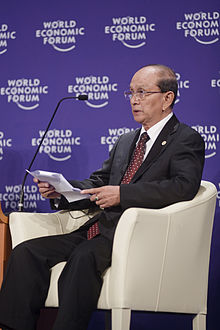
Myanmar President Thein Sein
While the Arab Spring has caused more ink to be spilled in attempts to explain why supposedly stable regimes were in reality brittle and vulnerable, another authoritarian state has begun to tentatively open up to the outside world. Much to the surprise of analysts who thought that the 2010 Myanmar elections would prove to be a sham that merely airbrushed the junta’s continued rule, recent events have suggested that the regime may be serious about liberalising.
Under the Presidency of Thein Sein, a former military officer, the new ‘civilian’ government, though it is composed of former senior military officers, has passed a new law loosening the ban on protests, though this has yet to be tested. Would-be protestors are required to apply for permission at least five days in advance.
Meanwhile, in an apparent attempt to address Myanmar’s ethnic divisions, the government has been reported to have called a ceasefire with the Shan State Army South, an armed ethnic rebel group. Aung San Suu Kyi, the country’s iconic pro-democracy activist, has also been released from house arrest and it seems that she will be permitted to return to politics.
Finally, the most obvious sign that the regime in Naypyitaw is liberalising somewhat is US Secretary of State Clinton’s recent visit. Allowing such a prominent figure to visit stands in marked contrast to Myanmar’s rejection of American aid in the wake of Hurrican Nargis.
The source of such a surprising turnaround is unclear. Some analysts have suggested that a rapprochement with the West could be motivated by a desire to avoid becoming too dependent upon China. However, while Naypyitaw has relied upon Beijing for arms and investment, particularly in the resource sector, it is also true that Thailand and India have proved to be more lucrative export markets. Myanmar is not the Chinese vassal state it is often portrayed to be.
Others, meanwhile, have suggested that some in the regime may have been repelled by the scale of the violence employed against protesting Buddhist monks in 2007. The military officers who formed the junta and who are now comfortably ensconced in the current civilian government have not, however, done anything in the past to suggest that they are squeamish about using force to perpetuate their rule, so this seems an unlikely motivation.
It seems more likely that events in the Middle East during the Arab Spring have concentrated the minds of those at the head of government. It seems plausible that they hope to tread a fine line between liberalising enough to give the average citizen a stake in their society and losing control, a path that Beijing is also attempting to stick to.
They may also hope to copy Pyongyang’s playbook: as a point of convergence between the great powers in the region, Naypyitaw may hope to play off the Chinese, Indians and, to a lesser extent, the Americans, against each other to its own advantage.
In short, the reasons behind Myanmar’s surprising direction are unclear. Thein Sein may prove to be Myanmar’s Gorbachev, though it should be noted that Gorbachev had no desire to break up the USSR, he simply wishes to modernise it. It seems safe to assume that those in government wish to preserve their leadership and that this desire will influence future decision-making.
 Asia Pacific Briefing