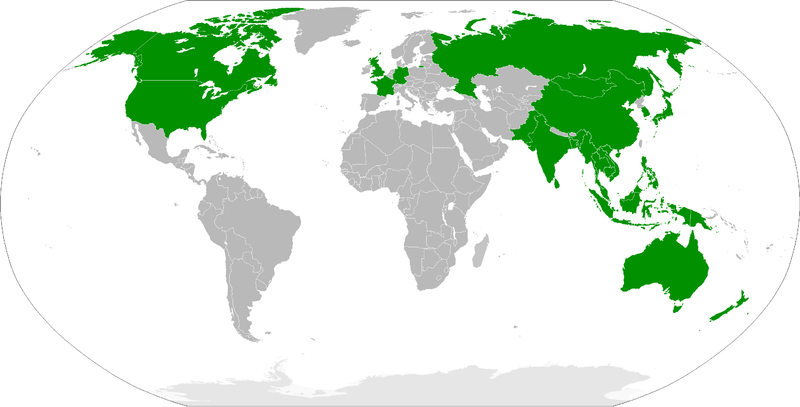
Shangri-La Dialogue member countries
June 5th saw the conclusion of the 2011 Shangri-La Dialogue. Hosted by the International Institute for Strategic Studies in Singapore, the three day event brought together Defence Ministers and military figures from the Asia Pacific region. What, then, were the main talking points of the weekend?
Perhaps predictably, the situation in the South China Sea dominated discussion. Many countries, particularly Vietnam and the Philippines, are increasingly concerned by what they consider to be China’s belligerent behaviour in the region. Vietnam points to cases of its fishing fleet being harassed by Chinese naval vessels. More recently, May 26th saw a confrontation which allegedly ended with a Vietnamese survey ship’s seismic cables being cut by a Chinese vessel as it conducted an oil and gas exploration mission.
This dispute provoked protests in Hanoi and Ho Chi Minh City as Vietnamese expressed their anger, though it is unclear whether the protests were encouraged by the government. While the Vietnamese government claims the survey ship was operating deep in its territorial waters and called the incident a “serious violation of Vietnam’s sovereignty”, the Chinese deflected criticism by arguing that Vietnamese oil and gas operations “undermined China’s interests and jurisdictional rights”.
This incident illustrates the potential for discord in the South China Sea, a situation exacerbated by the multitude of competing territorial claims held by such nations as China,Vietnam, the Philippines, Malaysia, Brunei and Taiwan. The Spratly Islands, for example, are contested by all of the countries named above and are thought to be resource rich. Ownership of the Paracel Islands, held by China, is also a matter of contention as Vietnam, which was evicted from the Islands by China in 1974, still claims ownership.
China, for its part, struck a more conciliatory note at the conference than it has been want to do when facing criticism from its maritime neighbours. General Liang Guanglie, China’s Minister for National Defence, strongly reiterated China’s desire for a peaceful rise, stating that Beijing does “not intend to threaten any country with the modernization of our military force”. China, argued Liang, has no desire to seek hegemony in the region. He painted China’s military budget, which is set to rise by an official 12.7% this year, as a natural improvement of its military equipment which, he highlighted, consists of “mainly second-generation weapons”.
Other countries in the region, however, remain unconvinced and continue to hedge against China’s military development, particularly its naval modernisation. At the Dialogue, for example, the Vietnamese confirmed that their government has purchased six Russian Kilo class submarines at a cost of US$3.2 billion, Thailand is thought to be considering the purchase of second-hand submarines from Germany and even the Filipino navy, which can ill-afford such expensive platforms, is thought to be considering the pursuit of a submarine capability.
It is in the context of this burgeoning Asian arms race that Washington has been seeking to re-establish its presence in the region after years of neglect due to its adventures in the Middle East. Robert Gates, the U.S. Secretary of Defence, spoke of his concerns regarding the possibility of a clash in the South China Sea unless all parties with an interest in the disputed waters agree on a mechanism with which to settle disputes. Such clashes, he stated, would not serve anyone’s interests.
Reaffirming the United States’ role as the Asia Pacific’s security guarantor, he promised that the fiscal situation his country finds itself in will not affect its commitments in Asia. Indeed, he wagered that over the next ten years the “U.S.influence in the region will be as strong or stronger”. Assuring allies of America’s intentions, he highlighted that Washington continues to invest in stealth aircraft, drones, warships and cyber weapons. Such capabilities, he argued, are the “most relevant to preserving the security, sovereignty, and freedom of our allies and partners in the region”.
Emphasising U.S.policy in the Asia Pacfic, he noted four “enduring principles” that should provide a framework for co-operation in the region: free commerce, the rule of law, open access to the global commons of sea, air, space “and now, cyberspace”, and peaceful conflict resolution. The reference to cyberspace seemed particularly pointed given Google’s recent allegations about hacking attacks emanating from China.
Of the U.S.–China relationship, Gates, keen to downplay the notion that China’s rise poses a threat to the region, stated that the relationship currently enjoys “a more positive trajectory”, but remains “underdeveloped”.
In an apparent hedge against China’s increasing assertiveness, however, Gates also announced that the U.S. Navy will establish a new base in Singapore. While Washington has maintained a facility there, the U.S.plans to permanently station one or two of its new Littoral Combat Ships in Singaporean waters, according to the Singaporean Defence Ministry. This move is part of “a number of steps toward establishing a defence posture across the Asia-Pacific that is more geographically distributed, operationally resilient and politically sustainable,” outlined Gates.
U.S.military planners are keen to spread their forces more widely across the region in order to make it harder for an adversary to strike a knock-out blow in event of a conflict. In addition, ongoing political troubles surrounding existing U.S.bases, such as Okinawa, makes spreading its assets around the region particularly attractive to Washington. Indeed, noting this, some analysts in Australia, most prominently Ross Babbage, have called for U.S.troops to be based in Australia.
It would however, be a mistake to think that the situation in the South China Sea was the only issued considered at the conference. The Japanese Minister of Defence, for example, spoke about the ongoing earthquake crisis in Japan, while Sergei Ivanov, the Russian Deputy Prime Minister, outlined the important of building strategic confidence in the region. The Malaysian Prime Minister, Najib Razak, echoed this sentiment, highlighting the global trend toward integration and interdependence. He also framed China’s rise as a cause for optimism rather than trepidation.
North Korea’s nuclear weapons program also merited discussion at the launch of a new book by Jonathan D. Pollack who has concluded that North Korea’s third nuclear test will probably be of a highly enriched uranium (HEU) bomb. Depressingly, he also believes that neither China nor the United States can stop or reverse the North’s nuclear weapons program.
In conclusion, the primary focus of the Dialogue was on the possibility of future quarrels – and how to deal with them – as Asian powers with rising military budgets continue to contest often potentially resource-rich territory. All parties agree that confidence building and co-operation is desirable. What remains to be seen, however, is to what extent such sentiments are reflected in behaviour. Will China continue to press its claims aggressively? Will this drive other Asian powers toward America and will an arms race develop in the Asia Pacific as countries attempt to balance China’s rise?
Other issues also continue to exercise analysts. The aftermath of the Japanese tsunami has crippled Tokyo. As Prime Minister Kan attempts to bring the situation under control and begin reconstruction, he faces an uphill struggle in the wake of the recent no-confidence motion. North Korea, too, is a continuing cause for concern. We certainly live in interesting times.



 Asia Pacific Briefing