
Preferences and Vital Interests

Shen Dingli’s recent Foreign Policy article makes a common criticism against recent U.S. policy toward Syria and Crimea.

He writes that,

 “…the record of Obama’s administration, and that of his predecessor’s, is of security assurances backed up lately only by inaction.  The United States has failed to stop Bashar al-Assad in Syria. It failed to stand up to Russia’s adventurism in the formerly Georgian territories of South Ossetia and Abkhazia in 2008, or in Crimea in March of this year.  Granted, none of these places are treaty allies of the United States.  But if the United States won’t face Russia in Europe, will it really challenge China in the East and South China seas?”

This echoes arguments made by other critics of the Obama Administration.  If the U.S. doesn’t stand up to Syria and Russia, they ask, how can it hope to deter China?

Such critics fear that if Washington’s Asian allies believe it doesn’t possess the will to enforce its preferences in the Middle East and Eastern Europe, they will question America’s willingness to defend them and seek to either bandwagon with Beijing or make greater provisions for their own defence, further destabilising the Asia-Pacific region.

Such criticism, however, stems from a failure to appreciate that judicious strategy distinguishes between preferences and vital interests.

Washington, of course, would prefer a secular liberal democracy to emerge in Syria.  It would also prefer a liberal democratic Ukraine free from Moscow’s malign influence.  Neither of these outcomes, however, can be easily achieved, if at all.  More to the point, the U.S. does not have a vital interest – defined as those interests which affect one’s security and that a state will use force to defend – in the outcome of either conflict.

First, Syria.  Chastened by its misadventures in Afghanistan and Iraq, Washington is not keen to get drawn into another Middle Eastern conflict.  Getting bogged down in another sectarian conflict in the Arab world would do little to promote U.S. security and would devour resources better devoted to supporting the Washington’s pivot to Asia.

As for Crimea, Washington has offered it no security assurances and is not treaty-bound to defend it.  Using force to do so would run the risk of a clash between U.S. and Russian forces.  The defence of Crimea or Ukraine, a weak, impoverished state on the periphery of Europe, is not worth risking a clash with a nuclear-armed Russia that has a greater stake in the outcome than Washington.

For those who argue that allowing Moscow to dissect Ukraine will encourage Russian revanchism, emboldening it to seek to regain territory it lost when the Soviet Union collapsed, a little perspective is required.

Its latest actions have weakened, not strengthened Russia.  It has estranged itself from Europe and its neighbours will now be more alert to any actions that suggest Moscow is looking to redraw its borders.  Should it seek to embark on such a course, it will likely result in a balancing coalition forming against it.

Should a European balancing coalition form against it, Russia would find itself in a weak strategic position.  Europe possesses a population five times greater than Russia and enjoys a GDP eight times larger than its eastern neighbour.  The U.S. could certainly act as an offshore balancer, but it need not man the front lines.  Contemporary Russia is not the Soviet Union; Washington should expect its European allies to do the heavy-lifting.

What, then, does this mean for Asia?  I believe that Asian leaders recognise these realities and privately applaud Washington’s decision to remain relatively aloof from the conflicts in Syria and Ukraine.  After all, it isn’t in their interests for Washington to dilute its strength by taking on new security commitments in the Middle East and Europe and it certainly isn’t in their interests for the U.S. to get bogged down in conflicts in these regions.

In conclusion, it is telling that only one Asian power would identify a benefit in U.S. involvement in Syria and Ukraine.  It’s the same power that benefited from Washington’s strategic distraction in the War on Terror and the ill-judged wars it fostered.  Beijing would be only too happy to see Washington’s strategic attention focused on Syria and Russia.  By declining to get involved in conflicts of marginal importance to its security, America is better able to marshal its resources for the purpose that will shape its security in the 21st century, balancing China’s rise.
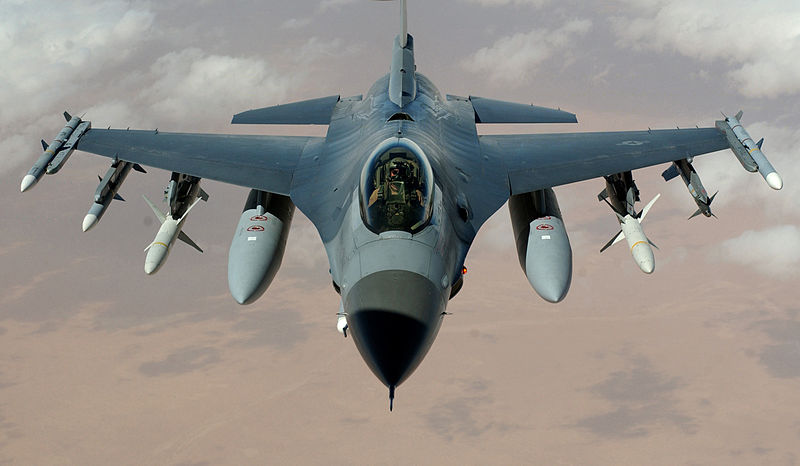
 

US to Upgrade Taiwan’s existing F-16 Fleet

The Obama Administration has decided to upgrade Taiwan's existing F-16 fleet

The Obama Administration has decided not to sell Taiwan the latest variant of the F-16.  Instead of being permitted to purchase the latest F-16C/D variant, Taiwan will have to be satisfied with upgrades to its current, and ageing, F-16A/B fleet.

This decision seems likely to have been prompted by a number of factors.  Firstly, and most obviously, it seems probable that decision-makers took into account China’s objections to further arms sales to what Beijing considers a rogue province.  With the US keen to build ties with China, it will have been anxious to avoid a repeat of China’s reaction to Washington’s decision to sell Apache gunships to Taipei in 2010.  Beijing cut military-to-military ties with Washington in response.

Given recent scandals concerning Chinese espionage in Taiwan, It is also likely that the White House is concerned about the possibility of Beijing gaining access to information about the latest F-16 model.  The US refusal to consider selling its latest F-35 fighter is also indicative of this concern.

The decision to upgrade Taipei’s existing F-16 fleet was probably the most palatable option for the US.  Some analysts, for example, have argued that with upgrades to the F-16A/Bs, the aircraft may be almost equivalent to the latest variant, so Taiwan gets an improved aircraft, Beijing will object less vigourously than it would to the sale of new aircraft while Washington signals its continued support for Taiwan.

There has, however, been some criticism of the decision.  Some members of Congress, such as John Cornyn (R-Tex) have objected to mere upgrades and signaled their desire to force the Administration to sell the latest variant, highlighting the importance they attach to the support of Taipei in addition to the economic benefits to the US.  Lockheed Martin, hardly, it must be admitted, a disinterested observer, estimate that sale of the latest variant could generate as much as $8.7 billion and create up to 23, 000 jobs.  It has also been claimed that without the sale of the C/D model the F-16 production line may prove to be unsustainable.

Others, looking at the wider picture, have portrayed the decision as a capitulation to Chinese pressure which will fail to reassure US allies in the Asia Pacific of Washington’s continued commitment to their security.  Despite the best efforts of Secretary of State Clinton to assert that the US is back in Asia to stay, doubts persist among Asian allies about American staying power in the region.  Witness efforts by countries as diverse as Australia, Japan, the Philippines, South Korea and even Vietnam to encourage a renewed and increased American presence in the region.  Should the US be seen to fail to support Taiwan, it may result in regional capitals drawing uncomfortable conclusions regarding Washington’s commitment to their own security.

In addition, while this upgrade will improve Taiwan’s existing F-16 fleet, it will do nothing to replace its Mirage and obsolescent F-5 aircraft, meaning that the lethality of Taiwan’s air assets will continue to deteriorate.  This stands in marked contrast to the Chinese trend of continued and rapid modernization of its air and ballistic missile forces, many of which are deployed within easy reach of Taiwan.

In conclusion, then, this decision seems to be an effort to satisfy everyone, but which satisfied no one.  US support for its allies will be called into question, Beijing will still object to the upgrades, and Taiwan does not get a new fighter with which to replace ageing aircraft and balance against China’s military build-up.


Prospects for U.S. – China Military Talks

Next week will see the resumption of military to military talks between the U.S and China.  Coming in the wake of the U.S.– China Strategic and Economic Dialogue, what can we expect from this exchange?

Since the last such talks in 2009, China’s domestic and foreign posture has become more assertive.  Domestically, the Chinese government has cracked down on dissidents with renewed vigour, most notably in the sentencing of Liu Xiaobo, the 2010 Nobel Peace Prize winner, for subverting state power, and the recent detainment of the artist Ai Weiwei, ostensibly related to as yet undetailed financial crimes.  In addition, the recent inchoate online calls for a Jasmine Revolution to mirror the current turmoil in theMiddle East has spooked the CCP who fear any example of resistance to authoritarian government.

China’s foreign policy has also displayed a harsher edge.  While for some time Beijing’s diplomacy won some prestige and plaudits through its involvement with the Six Party Talks on North Korea’s nuclear weapons programme, from 2009 China began to consciously lean toward Pyonyang.  When North Korea sank the South Korean corvette, Cheonan, the Chinese refrained from criticising North Korea, alienating Seoul.  This state of affairs was only exacerbated by Beijing’s muted response to the DPRK’s shelling of Yeonpyeong Island.

This has had the twin consequences of pushing South Korea closer to the United States and, surprisingly, given Seoul’s historical grievances against Japan, has even led South Korea to investigate the possibility of a military pact with Tokyo.

Japan was also taken aback by the Chinese response to its arrest of a Chinese trawler captain whose vessel rammed a Japanese patrol boat.  Although Japan ultimately repatriated the fisherman, China’s aggressive reaction – holding up the export of rare earth minerals, demanding an apology and detaining Japanese citizens resident in China in an apparent retaliatory gesture – concentrated Japan’s mind on the possible future threat represented by China.  Such thoughts are not reassured by the continued presence of Chinese submarines in Japanese waters nor by the buzzing of a Japanese destroyer by a Chinese military helicopter off Okinawa in March.

The Philippines has also complained about the treatment one of its survey vessels received in the resource-rich South China Sea.  According to Manila, Chinese patrol ships threatened to ram the survey ship.  Vietnamese fishing boats have also been harassed by Chinese vessels.

The issue of China’s maritime actions came to a head in the summer of 2010 when the PLA claimed “indisputable sovereignty” over the South China Sea, albeit with the caveat that it would allow others to freely navigate these waters.  The suggestion that the Chinese consider the South China Sea a core interest was of considerable concern to others who claim territory in these waters.  The Vietnamese, for example, continue to claim ownership of the Paracel Island Chain, from which China evicted them in 1974.  They also differ on ownership of the Spratly Islands, while countries such as Malaysia, the Philippines and Brunei also claim ownership over parts of the sea.

Finally, the Chinese also chose to unveil and test its J-20 fighter jet during the visit of U.S. Defence Secretary Robert Gates.

The reasons behind this new assertiveness are unclear, but it seems probable that it is the result of a number of factors, such as poor co-ordination between Chinese bureaucracies, a lack of control at the very top allied to the sense, particularly in the wake of the Global Financial Crisis and the relative decline of the West vis-à-vis China, that now Beijing is strong enough to adopt a more assertive and aggressive foreign policy.

The U.S. for its part has also been active.  In 2009, Vietnamese officials were invited to visit an American aircraft carrier, the USS John C. Stennis in an apparent attempt to continue to build links withVietnam as a hedge against China.

July 2010 saw U.S. Secretary of State Hillary Clinton give a speech at the ASEAN meeting in Hanoi in which she emphasised that Washington considered any territorial disputes in the region to have global implications because of its role as a trade route and source of natural resources.  She particularly irked Beijing by suggesting that the U.S.could act as an arbiter in any such regional disputes, offering support for smaller South East Asian states anxious about the prospect of bilateral disputes with Beijing. China’s Foreign Minister, Yang Jiechi, was particularly riled by this, stating that Clinton’s words were “an attack on China” and adding, in conversation with George Yeo, the erstwhile Singaporean Foreign Affairs Minister, that “China is a big country and other countries are small countries, and that’s just a fact”.  Such remarks further alienated China’s neighbours.

Clinton followed this trip with an October tour of a number of countries around the Asia Pacific, including China, aimed at re-affirming Washington’s commitment to the region.

This, then, is the background to the resumption of talks.  While both sides are unhappy at the actions of the other, they realise that they have common interests and that their relationship is too important to neglect.  As American power declines relative to that of the Chinese, such talks will become increasingly important.  Small and middle power countries in the region will look on with interest and hope that American engagement in the region will restrain the Chinese. Beijing may look at the resumption of these talks as a way to begin to undo the suspicion that its clumsy diplomacy of the last couple of years has created amongst its neighbours. Beijing is still keen to promulgate its narrative of a harmonious rise that promises no ill to its neighbours or the wider world.  While it is unlikely that these talks will result in any radical outcomes, it is to be hoped that their resumption will lead to further development and maturation of the most important bilateral relationship in the world.